
Today's Guest: Robin Goad
Today, I interview Robin Goad who grew up believing that if her own mother did not love her enough to protect her, then she must be unlovable. From a young age, she learned to perform. Achievement was praised. Expectations were high. On the outside, she looked confident and capable. On the inside, she was hiding pain and building a life around approval.
That pattern followed her into adulthood. She excelled in corporate America, rising into leadership while staying driven by performance and approval. At home, she was in a painful marriage. Then she made a choice that went against her own values, a choice that forced her to confront the life she had been living.
But what felt like a nervous breakdown was actually the beginning of something new. Alone and finally facing herself, she uncovered the lie she had been living from for decades. Facing that lie marked the turning point in her life.
Today, Robin shows up differently. Through her book Girl by Birth, Woman by Fire and her coaching, she creates space for women to be real and authentic, to tell the ugly raw truth without judgment. She helps women heal from trauma and guides young women in corporate America to discover their superpowers and rise without losing who they are.
__________________
Robin Goad is a powerhouse technology executive at Amazon Web Services, speaker, and coach who helps ambitious women master the corporate game without losing themselves.
With over 30 years of leadership across Fortune 100 companies like Dell and Gartner, she has closed billion dollar deals, earned recognition as Dell’s Working Mother of the Year, and built a reputation as a warrior in heels.
But Robin’s journey was not paved in perfection. It was forged in fire. Behind the titles were battles with childhood trauma, divorce, and a breaking point that forced her to confront the lies she had believed. That moment became her turning point.
As the author of Girl by Birth. Woman by Fire., Robin equips women with her R.E.A.L. Framework and The Unwritten Rulebook, practical strategies for thriving in corporate America and in life. Her message is simple and bold: you can achieve extraordinary success without sacrificing your soul.
Watch the episode:
Connect with Robin Goad
Learn How to Speak Without Fear!
Also listen on…
Transcript of Interview
Transcript of Interview
Find Your Voice, Change Your Life Podcast
Podcast Host: Dr. Doreen Downing
Free Guide to Fearless Speaking: Doreen7steps.com
Episode #179 Robin Goad
“Success that Hides the Truth”
(00:00) Doreen Downing: Hi, this is Dr. Doreen Downing. I’m host of the Find Your Voice Change Your Life podcast, and I’d like to welcome you today to another episode. I’ll be speaking with Robin Goad. Hi Robin.
(00:13) Robin Goad: Hi. How are you?
(00:16) Doreen Downing: Well, it’s morning time here and I know you’re in Texas, and we’re going to have a great conversation about you, your life, your struggle. I know that there are some interesting stops along your road that might have held you back, but somehow you found your way, broke through, and now you’re making this significant contribution.
You sent a bio, so I think I’d like to start there so at least people, even when they get to know the details of the struggle, get to say, yes, but look at what she’s become.
Robin Goad is a powerhouse technology executive at Amazon Web Services, a speaker and a coach who helps ambitious women rise in the corporate world without losing who they are. With more than three decades of leadership in Fortune 100 companies, she has closed billion dollar deals, been recognized as Dell’s working mother of the year, and earned a reputation as a true warrior in heels.
Her path has never been about perfection. It has been shaped by fire. Behind this impressive title, and this is where we’re going today to start, are the early wounds, a difficult divorce, and a moment of collapse that pushed her to confront the beliefs that had been holding her down. That reckoning changed everything.
As the author of Girl by Birth, Woman by Fire, Robin now shares the lessons she fought to learn. Through her REAL framework and the Unwritten Rule Book, she gives women the tools to navigate the unspoken challenges of corporate America with clarity, confidence, and integrity.
Her message is both simple and profound. You can rise. You can lead. And you can do it without sacrificing your soul. I love that intro. It just feels like we could talk all day around all those.
(02:48) Robin Goad: I would love to.
(02:49) Doreen Downing: That’s what you’re on this earth to do. That’s what you led yourself to be able to do, is to talk all day and probably lead retreats, do whatever is called for you to step in and lead us to rise and to become more of who we are.
But first there was a story. There was a history. In some ways, I think we pop out with this gift that we have to give to the world, and then something happens. It’s either the environment or maybe we’re a little more shy, or there are just ways in which we aren’t fed or nourished in the way that we need to be as little girls to say, look at me. I can. I can. I can. And you can.
So let’s start there, Robin. Your early childhood.
(03:51) Robin Goad: Early childhood. So I’m an only child, and my mother used to always say, you’re the only one I have, so you have to do everything.
(04:00) Doreen Downing: Oh.
(04:01) Robin Goad: And so I did. I remember from a very young age, piano lessons, dance lessons, softball, basketball, cheerleading. I played in the band. If there was student council, when I got up into middle school and high school, leadership positions. My mom really did set that mantle on me that you’re the only one I have. You are going to do everything.
I learned at a very young age that in my core family with my mother and my grandparents, that most immediate group of folks around me, performance was valued. The expectations were high, and those family members that didn’t meet expectations were not well regarded. I learned that hard work was very valuable and performance was valuable.
So I started tap dancing, literally and figuratively, at a very young age. That really carried me through middle school, high school, and into college. I oftentimes joke, but behind every joke there’s a little bit of truth, that I’m grateful I became addicted to performance because I could have become addicted to destructive things.
My parents got divorced when I was 7, and my people pleasing and trying to live up to expectations intensified. My mom married an abusive alcoholic as my stepfather. There was a lot to unpack there, but I had these two parallel lives. I had the life that nobody knew about, which was the abusive alcoholism in the family behind closed doors. Then I had the performance and the appearance and all the things that people got to see on the outside.
That worked. Nobody knew what happened behind closed doors, and everything on the outside looked great. That became my operating procedure for my entire life.
(06:54) Doreen Downing: Yes. Just already I’m feeling that the listeners are going, wow, they can relate, because the way you described it, the hidden and then what’s more visible, is so opposite.
I would say that’s also a part of my life, with my mom having mental illness and being in and out of hospitals for depression. My grandma took care of us, and yet on the outside I was just like you, the teacher’s pet.
It’s interesting that you had the influence and the support and what feels like the applause from parents and family to perform. I don’t know how I did it because nobody was applauding. Nobody was there. Maybe it was just instinct to survive.
I’m hearing that in order to fit in and survive, especially if you have something to hide, you learn.
(08:02) Robin Goad: Exactly. When I was thinking about this podcast and I was thinking about finding my voice, if you would have asked me any time in the last 20 years if I ever didn’t have my voice, I would have said no. I was very vocal. I always thought I had a voice. I never once thought I didn’t have a voice.
However, it was the authenticity of that voice that I would not come to own until much later in life. I always had a voice, and like you said, maybe that does come from the applause.
Everybody in my family thought that of me. My maternal grandmother was such an influence in my life, but her standard was perfectionism. Her standard in everything in life was perfect. That is what she expected, and it is how she lived her life. That is what she expected of others.
She was my biggest fan, and I loved the praise and approval. Praise and approval is great when it is healthy, but when it becomes your drug, it can be so destructive.
I oftentimes joke that I was a perfect candidate. Corporate America is the perfect place for a girl that wants approval and applause and is performance based, because corporate America will do all those things for you as long as you keep performing and delivering. It is this constant cycle. That has been the cycle that I was in for the first 40 something years of my life.
(10:06) Doreen Downing: I definitely want to get into that, and I’m glad you made the connection. There are so many people that I have interviewed on this podcast, and people can go back, but it is more about the voice of the corporation, not the true voice.
In a way, that is what you have already been showing us. Where is this voice coming from? Is it pressure to perform? Is it out of fear that if you do not, you are not going to get the applause or the approval? Or is it coming from authenticity? I love that you brought that word in earlier.
Before I move on to the journey to find your voice, this is a little more raw and tender, but I know listeners always appreciate understanding the abuse. I do not know if that was to you or whether it was to your mom. If you could say a little bit more, because that is where the wound is.
If you could just tap in a little bit and tell us about the wounding.
(11:17) Robin Goad: I have a lot of wounds that go back. We could do whole shows on all the different paths of those wounds.
My stepfather was never verbally or physically abusive to me. He was verbally and physically abusive to my mother. At a very young age, in third grade, I was taking care of her depending on what happened that night.
There was one particular evening I will tell you about. He had come home. He had been drinking. He was drunk. He held her up against the wall with a pistol in his hand, and he put bullets in the chamber playing Russian roulette. He held the gun up to her head, telling me that he was going to kill her and he wanted me to be there to watch.
She was screaming at me to leave. Please get out of here. I do not want you to see this. What do you do as a third grader? Do you leave and go get help? He had ripped all the phones out of the walls in rage. I could not make a phone call because he had ripped them out.
I remember running over to a friend to get help, and some friends came to help us that night.
The abuse was a constant cycle. He was an alcoholic, so he would have these bouts of insanity and rage and all the horrible things. Then he would try to get better. He would try to do AA. It was just a cycle. We were in between the highs and the lows all the time.
It was a very chaotic place to grow up. My mom finally left him about 5 times between third grade and graduating high school, but always went back. It was a constant leave, go back, leave, go back.
Finally, she left him for the last time my senior year of college.
(13:58) Robin Goad: He had beat her up pretty bad. She finally left him for the last time my senior year of college. That was my upbringing.
(14:13) Doreen Downing: That is, I mean, I asked for a story, didn’t I? I got it. That is out of the movies. That is true violence and drama. Here is this little girl who has the weight of life, almost like life and death, in her hands. I really appreciate you.
(14:34) Robin Goad: I wouldn’t tell anybody. I never told.
(14:37) Doreen Downing: That is the hiding.
(14:39) Robin Goad: I never told my grandparents. I never told my biological dad that I still had a relationship with. I never told anybody what really went on at home. I do not know why I did not, to be honest. I do not know if I was scared they might take me. I do not know. We just lived.
If you add in our church and our faith, I grew up in a Christian home. I went to church three times a week with my mom, and we never told anybody at church what was really going on at home either.
My life was always very compartmentalized. A lot of hiding. A lot of performance. A lot of looking good on the outside. Never letting anybody know what was really going on on the inside. That was my reality. That is the way I grew up.
(15:44) Doreen Downing: You asked yourself why it was not more public. As little ones, we follow the model of what the parent is doing. You saw what your mom was doing. In a way it was natural. This is what you learned to do.
You learned these patterns early on about hiding and that it is safer to be out performing. But somewhere along the line, you wake up.
As we move into that, what was your journey of awakening?
(16:25) Robin Goad: It is not pretty because I repeated the pattern that I learned.
I get married right out of college to my first husband. We are married 6 months and we are already separated. I was going, I am not happy. This is not what I wanted.
He never beat me physically, but he certainly beat me verbally. I would stand in his face and say, please hit me, because I made a vow a long time ago that if a man ever put his hands on me, based on what I had seen growing up, I would leave.
But he would never put his hands on me. I would stand in his face and try to get him to hit me because if he would just hit me, I would leave. He would never hit me.
It was verbal abuse. I was fat, stupid, and ugly.
(17:26) Doreen Downing: You were daring, right? The movie continues.
(17:32) Robin Goad: He would tell me every day, fat, stupid, and ugly. Fat, stupid, and ugly. I believed that. I believed he knew the real me and I was fat, stupid, and ugly.
I would beg him to hit me and he would never hit me. I ended up having an emotional affair.
Many years later, my first ex husband and I went to counseling. I remember sitting in counseling one day and the counselor said, Robin, if you were in a room with 100 men, you are going to pick the exact same guy, so you might as well stay with the devil you know. It is better than the devil you do not know.
(18:32) Robin Goad: I was ready to get divorced. He said, your background, you’re so messed up that you’re just going to keep picking the same kind of guys. The devil you know is better than the devil you do not know.
I thought, well, okay. I guess so. So I went back to my first husband and said, okay, if I am always going to pick bad guys, I guess I will just stay with you.
(19:06) Doreen Downing: The idea is to change, not to beg.
(19:13) Robin Goad: The counselor never said, hey Robin, let us get you healthy.
(19:18) Doreen Downing: You could stay but get healthy, if it is possible. So what happened next?
(19:25) Robin Goad: I go back to the marriage and we stay married for 9 years. I have 2 kids. My career is great because I am performing and excelling. My career is great.
About 9 years into my first marriage, I end up having an emotional affair with a man at work. This emotional affair starts because this guy at work tells me I am smart and amazing and have value and I am beautiful. Nothing physical. Just positive words that I am not fat, stupid, and ugly.
He validates how smart I am and how good I am and how pretty I am. I have an emotional affair with this man for about a year.
We go on a business trip somewhere, and the emotional affair turns physical. I come home and I crumble. I crumble under it.
I would love to know the psychology behind how you can have an emotional affair for a year, but you have one physical moment and all of a sudden everything falls apart and you crumble to the floor. I do not know the psychology or physiology behind it, but I could lie for a year about the emotional affair. Once it turned physical, I could not. I crumbled.
(21:06) Doreen Downing: When you use that word crumble, it feels like the facade crumbled and you did not really crumble. What you were doing was birthing.
The birth can happen, but if you are trapped in a container that does not crumble or collapse, the new birth cannot show up.
Is it something like that?
(21:44) Robin Goad: It is. I ended up having a nervous breakdown.
After the emotional affair turned physical, I confessed to my husband that I had the affair. He said, it is okay. We will get through it. I forgive you. We will get through this.
I called a girlfriend and asked if she still had that cabin out on the lake. She said yes. I asked if the key was in the same spot. She said yes.
I went out to her cabin and I had what I call my breakthrough, my emotional breakdown. But it was really my emotional breakthrough.
(22:29) Doreen Downing: Ooh.
(22:30) Robin Goad: Because—
(22:33) Doreen Downing: I want to put a pause there. That moment, and I know it is a process, but it is a moment in life that you are talking about. I need to take a quick break, and we are going to let the listeners hang on this, you being in this cabin. We will be right back.
Hi, we are back with Robin Goad, who is giving us very detailed images and stories about her early childhood. It is both the performance that was appreciated, valued, and affirmed, where she had a place to say, look at me. But there was also a hidden aspect of abuse, alcoholism, and violence.
There is a way in which we ask, who is she really? Is she the person stuck in this kind of hell? If you are just tuning in now, make sure you go back and listen to the details of what Robin experienced. Or is she a performer? That is not really real either.
Right before the break, she was talking about her breakthrough moment. That is where we are picking up now.
(24:06) Robin Goad: I am in this cabin, and I took a book that Dr. Phil had written. I do not even remember the name of the book, but it basically said, go back and write down and identify those defining moments in your life.
It takes you back through a thought process and asks, what is your first memory as a child? Write that down.
My very first memory was the day my parents told me they were getting divorced and what I did that day after that. Another defining moment was when I realized how my stepdad was.
I went back and started writing all of these defining moments. I got to a core truth that I had chosen to believe when I was a little kid. It was a lie. It was not truth, but I had accepted it as truth.
The truth I had hung my hat on my whole life and made decisions around was this: if my own mother does not love me enough to protect me, then I am unlovable.
So I broke. I am laying on the floor in the cabin in the fetal position, bawling. Crying and crying, heaving, sobbing, releasing all of this trauma. That was what my 7 year old self believed was true.
I had based every decision around that belief. I skipped over my adolescent years of sleeping around and partying and really just being a mess. I had multiple abortions. That led me through another period of self loathing.
At the core, the lie I accepted as truth was that I was unlovable. If my own mother did not love me enough to protect me, then who else in this world would ever love me enough to protect me?
(26:52) Doreen Downing: Great question. You must have found the answer. What is the answer?
(26:58) Robin Goad: The answer is myself.
(27:00) Doreen Downing: Ah.
(27:01) Robin Goad: And my father, my heavenly Father. I am made in His image. That is enough right there.
(27:14) Doreen Downing: For those who are just listening, you will not be able to see this, but Robin is beaming. What a beautiful smile. She is radiating right now around this truth, around what love is and where it comes from.
Thank you so much.
Let us move on to talk about what is happening now in your life. What are you doing, and how do you bring this message of where love comes from and how do you help people?
(27:49) Robin Goad: I now have all these different components of my life, just like it has always been.
One part is that I really want to reach back and help women who have been abused, who have trauma, who need abortion healing, who have gone through divorce or affairs. One aspect is creating a community where women can be real and authentic. That is part of the problem. We do not have space for women to say the ugly, raw truth.
There is that component where I want to create community.
Then there is the professional corporate side. I want to go back and reach those Robins who are 25 years old, working in the corporate world. I want to tell them the real of how it works and how it is going to work. I will give them the playbook behind that.
At the end of the day, that is why I wrote my book. I wrote it because I wanted a vehicle to come on podcasts like yours and just talk about everything.
When people ask what my book is about, I say, being a woman. It is everything.
(29:13) Doreen Downing: A real woman.
(29:15) Robin Goad: A real woman.
Part one is about your relationships. The relationships you were born into and the relationships you create in your family and community.
Part two is about your vocation. What are you doing as your vocation? What were those dreams you had as a kid that were really inside of you? My degree is in journalism. I wanted to be a truth teller. It is crazy that my core being wanted so badly to tell the truth after a life of lies.
(30:03) Doreen Downing: That is because you know what lies do and what lies feel like. Maybe you came into this world wanting to be the truth teller. That is how we started today. We come in with our gift, and then life happens around us.
(30:23) Robin Goad: I want to go back to those young career women and explain that you can be authentically you. I can help you find your superpowers.
I did not realize the real core value I brought into those rooms 30 years ago when I started in corporate America. Once I learned my real superpower and the value I was bringing to the team, my career skyrocketed. I was in rooms I would have only dreamed of.
I want to help young women know how to navigate that.
The third part of the book is about health. Physical health, spiritual health, emotional health, and financial health. As women, we do not realize how important our financial, emotional, and spiritual health are, especially as we get into our mid 50s and menopause and think we have lost our mind and do not recognize ourselves.
That is my book. Those are the three pieces. I just want to show up authentically, with the bumps and bruises, and help other women. I did not have anyone I felt I could reach out to or relate to. I am hopeful there are a lot of Robins out there I can engage with and start helping.
(32:13) Doreen Downing: I am sure there are. This podcast is one way you will be reaching people. Many interviewees have said that after listening, they reached out to the guest.
It is like you are saying, hello, I see you. The seeing you is all parts. Not only the beauty and the power inside, but the parts you want to hide. I see them, and I am not judging them.
(32:52) Robin Goad: That is 100 percent. I do a lot of work with women in post abortion healing and around affairs. If you look at my life, it has been a train wreck. On this personal side, it has been atrocious. It has been full of trauma and hurt. On the professional outward appearance, I am super woman.
I have zero judgment for anybody. There is not a story you could tell me that I would be appalled at or afraid of. There is nothing you could tell me that would shock me or make me hold judgment because I have lived it.
(34:03) Doreen Downing: This is really fabulous to highlight you today and let people know there is somebody like you who holds truth and holds experiences that were very traumatic. Both the trauma and the truth. Maybe that is an article. Trauma and Truth.
(34:24) Robin Goad: That is a great title. Trauma and Truth.
(34:31) Doreen Downing: Let us wrap it up. I like to have you pause and reflect on our time together, knowing there are listeners out there who are saying wow to you and also waking up themselves, recognizing they are somewhere along that same journey.
What would you like to leave the listeners with today?
(35:05) Robin Goad: I want them to reach out. My website is therealrobingoad.com. They can book time with me for free. You can click Book Superpower Time with me, and I would love to start a conversation.
I know what it looks like on the corporate coaching side. That is very clear. They can book time with me, and I can help them find their superpowers and map out their career and do career coaching.
On the personal side, I do not know what that looks like yet. I just want to offer a place where we can build a community of real, authentic, inspiring women.
Book time with me. I would love to get to know them.
(35:57) Doreen Downing: Wonderful. I will have that in the show notes. That would be your website?
(36:06) Robin Goad: Yes. If you go to therealrobingoad.com, there is a box that says Book a Superpower Session. That books 30 minutes on my calendar for free.
(36:20) Doreen Downing: And you get to—
(36:22) Robin Goad: And we just get to know each other.
(36:24) Doreen Downing: Wonderful. Thank you so much, Robin.
(36:27) Robin Goad: Thank you.
Also listen on…
 Podcast host, Dr. Doreen Downing, helps people find their voice so they can overcome anxiety, be confident, and speak without fear.
Get started now on your journey to your authentic voice by downloading my Free 7 Step Guide to Fearless Speaking: doreen7steps.com.
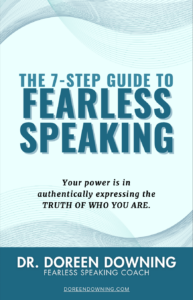 Podcast host, Dr. Doreen Downing, helps people find their voice so they can overcome anxiety, be confident, and speak without fear.
Get started now on your journey to your authentic voice by downloading my Free 7 Step Guide to Fearless Speaking: doreen7steps.com.