
Today's Guest: Riana Malia
Today, I interview Riana Malia, who grew up through repeated family breakups, broken promises, and the belief that she had to earn love. The instability left her feeling unsettled, too much in some ways and not enough in others, while also teaching her to become deeply resourceful.
Those early beliefs followed Riana through marriage, motherhood, financial hardship, betrayal, and relationships where she tried to manage outcomes and become who others needed her to be. Although she went to therapy, read the books, and talked about her experiences, the anger, sadness, and old story continued to shape her life.
Her breakthrough came when she realized that repeatedly telling the same story was keeping her inside it. She learned to stand on her story instead, let go of the belief that she had to beg people to love her, and become the same person in every room. That shift helped her break the cycle of broken promises and create a different life.
Today, Riana uses what she has learned to help women stop repeating the relationship patterns that no longer serve them. She helps them get clear about who they are, what they want, and the life and love they want to create.
__________________
Riana Malia is a Board-Certified Neurosomatic Practitioner, Identity Architect, and private authority for women who have built extraordinary lives and refuse to settle for ordinary love. Her methodology blends neurological rewiring, subconscious reprogramming, and nervous system recoding to address what therapy, retreats, and self-help have not been able to reach.
Riana is the creator of the Clear to Create™ Method, which helps women clear old patterns, create aligned beliefs and habits, and claim a new identity. She is also the founder and host of the Brilliance Brunch™, an invitation-only gathering for high-achieving women in the San Francisco Bay Area, and the creator of the Extraordinary Love Index™ (ELI™), an assessment that reveals what may be standing between a woman and extraordinary love.
Watch the episode:
Connect with Riana Malia
Learn How to Speak Without Fear!
Also listen on…
Transcript of Interview
Transcript of Interview
Find Your Voice, Change Your Life Podcast
Podcast Host: Dr. Doreen Downing
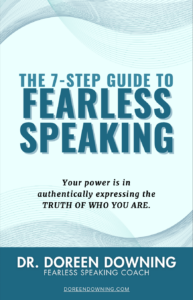
Free Guide to Fearless Speaking: Doreen7steps.com
Episode #189 Riana Malia
She Stopped Changing Herself to Be Loved
(00:00) Doreen Downing: Hi, this is Dr. Doreen Downing. Welcome to the Find Your Voice, Change Your Life podcast. Oh, I get to interview so many wonderful new friends that I’ve just recently had contact with, and Riana is somebody that I met at her Brilliance Brunch. How do you like that name? Brilliance Brunch. You’ll find out more about who she is and what she offers today.
Hi, Riana.
(00:32) Riana Malia: Hi.
(00:34) Doreen Downing: Good to welcome you to this podcast so that I can give you a platform and people can learn more, like I did just a few Saturdays ago in Northern California. We both are up here. Let me read a little bit about what you offer so that people get a better sense right away of what you do.
(00:58) Riana Malia: Great.
(00:59) Doreen Downing: Riana Malia is a board-certified neurosomatic practitioner, identity architect, and the most sought-after private authority for women who have built extraordinary lives and refuse to settle for ordinary love. Her clients are accomplished, resourced women who have succeeded in every area of their lives: career, health, family, relationships, and friendships.
But actually, the one thing they want is a partner that matches who they are. Riana’s methodology blends neurological rewiring, subconscious reprogramming, and nervous system recoding to resolve what therapy, retreats, and self-help haven’t been able to reach. It’s interesting to say “resolve,” but I think that’s a good way to say it.
She doesn’t go back into the story. She goes straight to the root of what’s been running the pattern and clears it. Riana is known for her visceral specificity, her unmatched warmth, and her ability to say the thing her clients have never said out loud.
She works privately with a small number of women each year and is the founder and host of what I just mentioned, the Brilliance Brunch, an invitation-only gathering for high-achieving women in the San Francisco Bay Area. Well, I guess I’m in that category, high-achieving women in the San Francisco Bay…
(02:47) Riana Malia: Area.
(02:47) Doreen Downing: That is because I got an invitation.
(02:52) Riana Malia: I always want to put an asterisk there because when we say “high-achieving,” sometimes people go, “Oh, well, that’s not me. I’m not a CEO.”
But high-achieving and high-capacity aren’t necessarily tied to career success. High-achieving women who are running a family, running a nonprofit, or volunteering their time at the local soup kitchen, all of that is achievement.
(03:17) Doreen Downing: Right. I would say what you’re saying is active women who are actively involved in their own lives.
(03:25) Riana Malia: Yes.
(03:26) Doreen Downing: They feel good about everything, but not quite good enough about the partnering they would like, as you said in your bio, that matches all of who they are.
Well, I have a sense of how I want to do this interview with you, but first, I want to go back. I’m touching my heart because it was really meaningful to come to the Brilliance Brunch with you.
I felt like you welcomed each one of us. There were about a dozen women there, and you gave each one of us a map. It was something about getting clear, then getting creative, and then claiming. Clear, create, and claim was a framework that you presented to us.
I just wanted to let you know that that was very meaningful for me and something I think any person who’s living an active life could come back to, to ask themselves good questions about being clear about something. With more clarity, you can create.
That’s what I learned from you, my dear.
(04:40) Riana Malia: Well, that makes me very happy.
(04:44) Doreen Downing: Well, you put it out there for us to learn from you, so thank you.
Today, we’re learning more about you and how you got to be the kind of woman who is so dedicated to helping us become more of who we can be.
Maybe you just popped out into the world saying, “Here I am, world. I’m going to work with women to help them become achievers or have more fulfilled lives.”
If we could start by dialing back to your early history, do you have any stories about not having a voice, not being heard, or not having the space to be who you are? Anything that would give us some early insights into how you started.
(05:38) Riana Malia: Yes. Well, to answer your question, I think when I did come into this world, it was like, “Hello, world,” but no, it was not, “Oh, I’m going to work with women.”
I think any of us who do the work that we do have a story and a journey. Part of getting to do the work that God has called us to do, or that we are blessed to do in this world, comes from the things that weren’t just wonderful, fantastic, and easy.
I grew up in Minnesota with my mom. My father lived in California. They were divorced when I was quite young. I was really lucky to have grandparents who were amazing, and I spent my summers and breaks at Gigi and Bumpy’s house in a tiny town in southern Minnesota called Blooming Prairie, population 2,400. I grew up in a horse barn.
The lessons from that and getting to experience it, we could have an hour-long conversation about just that.
Throughout that time, my mom was a single mom. She worked really hard and did the best she could in caring for me. But there was also a sense of being unsettled. There wasn’t necessarily always that sense of security. My dad was never really involved very much.
Then I went off to college, and he said, “Hey, listen, I’m going to pay for your room and board freshman year.”
I said, “Oh, that’s great. Thank you.”
I got to school, and I was 18 and doing the dorm thing. A couple of months in, I got a call that said, “Your bill was never paid. You are maxed out on loans, so you either have to figure it out within seven days, or you have to leave.”
When I was faced with that, I had to make a decision. I ended up staying. I got three jobs. I rented a five-bedroom house, filled the other four bedrooms, and did my thing.
But there was definitely that sense of, “Why? Why am I not as important? Why would you even set it up if you’re not going to do it? Why would you even put that out there?”
Then I got married at the very ripe old age of 23.
(07:43) Doreen Downing: Oh my gosh. Before you go too far, I just want to hold that because the listeners just heard that you’re bopping along in life, and then you have what feels like this major betrayal.
But there had to be some indications before you went off to college that this was already some kind of pattern. Your dad said, “I’ll do this for you,” and then he didn’t. Is that true?
(08:12) Riana Malia: Oh, for sure. Of course. Absolutely. My entire life.
It was, “Oh, I’m going to come see you,” or, “I’m going to come do this,” and then nothing.
There was also the knowledge that he had another family. He had three boys. I would hear, “Oh, we’re going to Tahoe,” “They’re in all these sports,” and, “They’re in private school.”
It was like he was oblivious to the message and the narrative that was giving me subconsciously. I was a little girl. I wasn’t processing it like, “Oh, interesting.”
(08:43) Doreen Downing: So they must have gotten divorced somewhere along the line, and then he remarried and had three boys.
(08:49) Riana Malia: They got divorced when I was about three, or maybe not even three. Very, very, very little.
(08:56) Doreen Downing: Oh, wow. Did your mom get remarried?
(08:59) Riana Malia: Oh, yes. Two more times, and divorced both times.
(09:02) Doreen Downing: Oh, Riana, that’s a lot. That’s a lot of early chaos and change in your life. I guess sometimes change and adjusting to it early on is helpful for us later on.
(09:23) Riana Malia: Yes. I think some of the things that are about survival also become part of what makes us who we are. I am so freaking resourceful. You pretty much tell me no or that I can’t do something, and I’m going to figure out a way. Or if you say, “I don’t know how to fix this,” I’m going to solve it.
But that’s a survival mechanism from reacting to, “Oh my gosh, something’s wrong. How do I fix it?”
(09:45) Doreen Downing: Oh, I’m so glad that I stopped the forward movement of this story and went back a little bit, because I think what you gave the audience today was, “Oh, all right. Something went haywire, perhaps, but you learned something from having things fragment and go in different directions.”
You became, and I love this word, resourceful.
(10:12) Riana Malia: I love it too, because I do think when things come up, whether we’re 18 or 88, that are really big and we’re not sure what to do, the boulder drops, and it’s like, “How in the hell am I going to get to the other side?”
We often think it’s a lack of resources: time, money, support, or energy. But it’s really about tapping into that part of you, because we all have it, that resourcefulness that says, “You know what? This isn’t the end. There’s a fire here, and there’s more meant for me.” Right?
(10:43) Doreen Downing: You are a fire, I tell you. I’ve had the experience of seeing you work your magic just like that when everything that morning wasn’t as you expected, and you went into your superpower, which is being resourceful.
I bet another word for you would be resilient.
(11:07) Riana Malia: For sure.
(11:09) Doreen Downing: Yes. That’s my impression of you.
I got hung up on the father betraying you. I was getting kind of clinical. But anyway, your dad did that. Again, it’s another example. I feel like that’s the theme of our time today, that life presents something to you, and you go, “Okay, what do I do? I’ve got to work it out, fix it up, and make my way through here somehow.”
You got three jobs, is that what you said, in college?
(11:46) Riana Malia: Yes. I was a server at a Mexican restaurant. I worked as a receptionist at the beauty school in downtown Duluth, Minnesota. And I worked at this cute little shop that was mostly cards, stationery, and paper.
During the holidays, there was a mall, and they had pop-up shops that weren’t really stores. There was a bonsai tree cart, and I worked there to make extra money to buy gifts.
(12:15) Doreen Downing: Oh, did you then make enough money to make it through school when they said you’re…
(12:21) Riana Malia: I had loans that I still have parts of, sadly, at 50. I had loans to get through school, but then I needed to figure out how to pay for a car, insurance, rent, food, and all the things you actually have to have to live.
(12:38) Doreen Downing: What were you studying in college?
(12:44) Riana Malia: I was studying communications and interpersonal relationships. I’m sure that doesn’t surprise you.
(12:51) Doreen Downing: No, not at all. I went to school and started in sociology, actually. I was at the University of California, Berkeley, in the ’60s when they shut the campus down and we had a Free Speech Movement. I’m still doing free speech, right, with Find Your Voice.
(13:12) Riana Malia: I think we maybe talked about that together, or maybe I just dreamt it. Sometimes I dream things and think they really happened. But my daughter is going to graduate from college in three weeks from SDSU with sociology and psychology degrees.
(13:28) Doreen Downing: Well, I’m sure there are many ties between us that are invisible but have probably brought us together. I trust that. So, college, and then you bounced out into what?
(13:44) Riana Malia: Marriage. At 23, I got married because I was certain no one was going to love me. I had a lot of evidence for that, right? My boyfriend in high school cheated on me, my boyfriend in college, my dad, all these things.
I was certain I was going to be this old woman by myself forever. Part of the flip side, the shadow side of resourcefulness, is also managing outcomes and getting really good at that.
We got engaged, then he called off the engagement. But I was certain that I knew better than the universe and this needed to happen. So I managed the outcome until we got back together and got married.
It was a very lonely marriage in a lot of ways, but we had our miracle baby. When I say “miracle baby,” she is literally a miracle child because she’s here.
We hardly had sex at all. Then we did, and I got pregnant and had a miscarriage. We weren’t together again for two years. Then we were together one time, and I got pregnant with Maddie. We were never together again.
The night before she was born, she was due Christmas Eve. She was born November 30th. The night before she was born, I was the maid of honor in my best girlfriend’s wedding, and we did the whole thing: dinner, dancing, and all the things. Then I went to brunch the next morning, where she opened her gifts. I went home and essentially went into labor.
My body was so lopsided, and we laughed that she only liked one side of me. When we ended up having to have emergency surgery, they said, “Your uterus is only half the size.” Her cord was wrapped around her neck, and she was breech. All the things. But she never had to go to the NICU. I mean, she was amazing.
It was a long, lonely time. When she was six, we were kind of like, “Okay, we’re going to be done with this,” and it felt calm. It really felt like it was going to be okay. The next day, something happened that made it not okay, and it turned volatile, crazy, and horrible.
(15:54) Doreen Downing: Wait, wait, wait. You mean health or something?
(15:56) Riana Malia: No. We went to mediation. We made all these agreements. It was going to be okay. We were going to take her to Disney World. My only request to my ex-husband was, “If you meet somebody, or you already have, whatever, just give Maddie this first year. When she’s with you, let her just be with Daddy. Don’t bring somebody else into the mix for a year. Just give her a year.”
The very next day, I called to check on her because she had a little cold, and she said, “Well, Daddy’s friend and her daughter are here, and we’re coloring Easter eggs.” So I went ballistic.
She didn’t get that time, right? It was immediately into this whole other thing. There were years of anger, rage, and sadness. When she was not with me, there were days when I literally couldn’t get out of bed because I was so upset.
I did all the things that we’re told to do, right? I went to therapy, talked about it with my friends, read the books, and did all of those things.
Fast-forward to when she was nine, my dad came to visit. Throughout my life, there had been a lot of, “This is the next big deal. This is going to be the thing that takes care of our whole family, this invention, this company,” whatever. None of them ever actually came to fruition.
He came in April, and it was freezing in Minnesota. We had just gotten about a foot of snow. It had been so cold, like 40 below zero, that the pump at my house broke. I lived on a little farm in a 100-year-old cottage. The pump was metal, and it snapped off because it was so cold.
In order to water the horses, I had to run a hose into the house, hook it up to the washing machine, and then unhook it. It was a whole thing. I’m an island girl. I am not made for winter, even though I grew up there. Long story.
He said, “Come take over this family business. Move to California.” I said, “Well, I’m not moving for the next big deal. I’m not leaving the horses.”
My mom, and remember, they had been divorced since I was two or three, had just had surgery. She did nails for a living, and she had surgery on a vertebra in her neck. They nicked a nerve, and she couldn’t move her right arm at the time. She was recovering and in pain. She was also self-employed, so she wasn’t bringing in income.
I said, “I’m only going to disrupt Maddie’s life one time. That’s it.” He said, “Nope. Here are the financials. Bring your mom. Bring the horses. We’ll build a barn. It’s going to be amazing.”
So against everything in my gut, I said yes. My chosen family, my best girlfriends who are like my sisters, were like, “Are you insane? We know this man. You cannot trust him.”
Honestly, though, I was tired. I was running an oncology company. I was raising my baby. It was freaking cold. It sounded like a little bit of a respite, if I’m being really truthful.
So we came to California. We came to Mill Valley, and the first few months were a magical fairy tale. I had this fun relationship with my dad and my parents. We were having Sunday family dinners and weekends with the horses. Maddie got to go to the beach whenever she wanted.
Then this whole thing happened, and I ended up in the middle of a DEA investigation. That relationship with my father was over. The business and all the assets were frozen. The stability I thought I had was completely destroyed, and I had to make another choice, like I did when I was 18: “Do I stay in school? Do I stay here?”
I could have moved us back to Minnesota. I probably couldn’t have brought the horses back, but that’s not the end of the world.
Or I could keep my promise to Maddie and break this generational cycle of broken promises and a lack of integrity in that parent-child relationship that gives you a sense of safety. At the end of the day, that’s what we did. We stayed.
After a period of time, I had several hundred thousand dollars in debt. But it was the beginning of what brought me to this work and, ultimately, to being married for two and a half years to the most incredible, amazing, perfect love-of-my-life husband for me. I think I can say for him, too.
But without the work, I would have never married him. I wasn’t capable of being the woman that I am. I was so attached to the identity of the story and all the stuff that I had been through and lived through, and then an abusive relationship when I moved here. All of it was very consuming around sadness, anger, betrayal, and hurt.
But what became evident to me is that when we stay in that space and continue to tell the story the same way over time, you’re just in it, right? You’re just in your story. There’s a difference between staying in it, which completely defines you, versus being able to do this work. Instead of standing in it, you stand on it, and then it gets to literally refine you.
I wouldn’t trade any of those insane experiences for anything, because without all of that, I’m not here. I’m not doing this work that changes people’s lives. I’m not married to Pete Davis. You’ve got to be grateful for all of it, not just the good stuff.
(21:23) Doreen Downing: Yes. Well, I’m going to take a brief break because I do want to come back to what you just said. You had this excitement and joy when you talked about the work that you get to do. I love that you’re appreciating every single moment of your life, and you aren’t dissing any part of it. You’re integrating it. So we’ll be right back.
Hi, we’re back with Riana Malia. Wow, what a story already of chaos, betrayal, abuse, and broken promises. Broken promises also seem to be a theme early on. Go back and listen, and you’ll get to know some of the history that has brought Riana today to be the kind of woman who is very dedicated and has new systems that will help people not only break through a past that may have them stuck, but also break through to a new life and new possibilities.
So we’re back now. Hi, Riana.
(22:41) Riana Malia: Hi.
(22:41) Doreen Downing: Thank you for all those details. There were a lot of details, and I’m not going to go back into them because where we are now is just to give you more of a platform.
We’re talking about voice, and in a way, it seemed like you had a voice, but it was a voice for yourself. Maybe nobody around you listened. Before we move further into what you do, how did you find your voice?
(23:19) Riana Malia: I didn’t really find it. It’s interesting when you say that because I can look back at times in my life when I thought I had it, when I felt like I did, but the truth is that I didn’t.
The underlying narrative and current for me was always that I had to beg people to love me. I had to make them love me. I had to do something or be different, right? Because I had too many big ideas, and I was way too much, and then I wasn’t enough in this other area. I had to become somebody I wasn’t in order to be loved.
That’s a false sense of finding your voice. I didn’t really find my voice, honestly, until 10 years ago, and I just turned 50. I let go of all those stories that I was too much, too broken, too this, too that, all the stuff, and I was able to just be me in all of me.
I can be a lot, right? I get ideas, and I’m like, “Let’s go do this.” But that’s part of what makes me amazing. That’s just who I am.
I’m able to be all of me, and I’m the same person in every room. It doesn’t matter if we’re at the grocery store or at the opera. I’m just me. For me, that’s the definition of really finding my voice. I don’t become a different person in any situation or feel like I have to in order to have somebody like me or love me, or whatever it is.
(24:48) Doreen Downing: So how does this come into the work that you’re doing nowadays with people? I love the word “amazing.” I know that’s how you feel about yourself, and you radiate that.
By you radiating amazing, it touches those of us who are listening to you, and we find our own amazingness.
(25:17) Riana Malia: I also want to say that I 100% know I’m amazing and I have an amazing life, but that doesn’t mean there isn’t still hard stuff, right? I’m not immune to it, but I don’t stay in it.
That’s the beauty of this work, right? It’s not about, “You’re never going to have these thoughts or these processes again,” because we’re human. I’m not going to give you a lobotomy. But I’m going to teach you how to pull yourself out of it in seconds, not hours, days, weeks, or months.
The basis of the work, and you can see my fun little thing, is that my thing has always been “your very best life.” Whether we’ve been friends for 10 minutes or 100 years, I want you to live your version of your very best life. There’s a different definition of that for every single one of us.
(26:08) Riana Malia: That’s beautiful. But the truth is, you cannot go from past pain and betrayal, childhood stuff, divorces, failed businesses, and all the things we experience in life to just living your very best life.
We have to clear before we can create. We have to clear the story to create the life. Everybody says, “I want a different story.”
I say, “Great. Stop telling the old one.”
(26:36) Riana Malia: Right? Stop telling the old one. But you talked about this earlier. We have to clear the cycles to create the confidence, right? Those patterns. We have to clear the patterns to create the partnerships.
We want loving, fulfilling partnerships in our friendships, romantic relationships, business relationships, and communities. But when we bring all the old patterns, we don’t get those partnerships. What do we get? We get more of the same, which is typically what we don’t want, right?
“I don’t want to be in another relationship where I feel unloved. I don’t want to be in this financial position. I don’t want to be in this job that I hate. I don’t want to be in a relationship where I don’t feel like I can trust this person.”
The problem is that 90% of us is the unconscious mind, and it doesn’t hear the qualifying “don’ts.” It just knows what you’re focused on. It’s why people end up in the same circumstances over and over in life. They date the same person, marry the same person, and end up in the same situations in every job they go to. “The boss hates me,” whatever it is.
It’s so simple and so complex, but it’s where it all starts because we are focused on those things. We have to clear the resentment to create the results.
(27:55) Doreen Downing: What you’re talking about is that people are saying, “I want this,” which is not what they currently have. Then they have to do the clearing first. That’s the process I think you’re talking about. You can’t even create until you’ve got more clarity, more space, or more of a clearing out from which you can create.
(28:20) Riana Malia: One hundred percent. To your point, before you can clear anything, you have to get clear, and that’s where this work starts. It’s at a level of specificity and clarity. When we really talk about clarity, that becomes your menu, right? It’s your values, your non-negotiables, and your desires.
I think we talked about this at brunch, but I’m going to say it again because I think it’s so good. It’s like going to a restaurant and sitting down. The server comes by and says, “What can I bring you?”
We say, “Well, I’m thirsty. I’d like to start with a salad, some protein, and a vegetable.”
They bring us an iced tea, a Caesar salad, a beautiful roasted chicken, and some potatoes. We got exactly what we ordered, 100% exactly what we ordered.
The problem is, I wanted a glass of champagne, an arugula salad with figs, goat cheese, and beets, a lovely piece of salmon, and some roasted asparagus.
When I ask people, “What do you want? Who are you now?” people will say, “Well, I know what I want. I know who I am.” But they’ve never been asked in a way that gets that clear.
When we have that, you have your menu. It’s why most people go through life almost getting what they want, kind of getting what they want, and then longing and wondering, “Why does it never happen for me?”
(29:41) Doreen Downing: Well, I know that the women that day at the Brilliance Brunch mentioned breakthroughs from working with you. How do people learn more about this process you’re talking about, getting clear, then creating, and then claiming? How do they find out more about working with you?
(30:09) Riana Malia: Sure. You can find me on all the socials: Instagram, TikTok, Substack, Facebook, LinkedIn, and YouTube, at Riana Malia. My website is the same, rianamalia.com. But I’d also love to give your listeners a gift, if I may.
(30:25) Doreen Downing: That would be fabulous. Thank you.
(30:28) Riana Malia: Something I’ve created over the years, developed, and continued to refine is called the Extraordinary Love Index, which we lovingly refer to as the ELE.
The ELE answers the question, “What is standing between you and extraordinary love?” It’s not just romantic love, right? It starts here. It starts with self-love.
It is an actual accredited diagnostic, so it’s 40 questions. It’s not the “What Disney princess are you?” quiz. Give yourself a good 10 or 15 minutes to answer those questions thoughtfully because it looks at nine key areas. Then I’m going to send you a 28-page personalized report that looks at all those areas and breaks them down for you based on what you said.
It’s going to show you, “Based on this, here’s what’s probably showing up in your life. Here’s the cost of staying here, and here’s something you can do right now to move forward as the person you are and are becoming.” Not this old identity, but the one you’re stepping into.
That’s my gift, and I think everyone should take the ELE. I review all the data, and it’s fascinating. Thousands of people have taken the ELE.
My invitation is to go take the ELE. If there’s something inside of you that says, “I want to have a conversation about what’s possible,” just reach out to me. We can have a private conversation and explore what’s next for you. Where are you? Who are you? What do you want between now and dead?
(32:06) Doreen Downing: Between now and dead. What do you want? I thought that was what you said.
(32:13) Riana Malia: Between now and dead, what’s the life that you want to live?
(32:16) Doreen Downing: Thank you. You have a lot of humor, too.
Well, we’re at the end, and I like to open up. Take a big, full breath, an easy breath, a gentle breath, and tap into what wants to be said as we come to a close today.
In opening up my listening to what comes through right now for you, I feel like my heart is smiling, and I’m dancing with you. What about you?
(33:06) Riana Malia: What is coming up for me is really the dance between understanding how blessed we are and still having days that feel really effing hard.
No matter how much we learn, how much work we do, or how many tools and resources we have, there are still going to be days, situations, or circumstances that feel hard.
But the butterflies around that for me are the knowledge, clarity, and confidence that it doesn’t last and it’s all solvable, right? It’s all solvable. Never believe the voice in your head because she’s a liar.
(34:01) Doreen Downing: Well, I think I just want to go, “Done.”
But I also heard the butterflies, and I like that analogy. I know I gave you the last word here, but I guess I just want to keep talking to you.
I think my listeners have been stimulated, which would be a good word, by your energy, what I noted earlier about your fire, and your beliefs. That’s it. What you believe is possible for people helps them begin to see it for themselves.
(34:48) Riana Malia: Yes.
(34:49) Doreen Downing: Thank you for your vision and for helping women become more of who they already are. Thank you. It’s an honor. All right. Thank you.
Also listen on…
 Podcast host, Dr. Doreen Downing, helps people find their voice so they can overcome anxiety, be confident, and speak without fear.
Get started now on your journey to your authentic voice by downloading my Free 7 Step Guide to Fearless Speaking: doreen7steps.com.
 Podcast host, Dr. Doreen Downing, helps people find their voice so they can overcome anxiety, be confident, and speak without fear.
Get started now on your journey to your authentic voice by downloading my Free 7 Step Guide to Fearless Speaking: doreen7steps.com.