
Today's Guest: Amy and Nancy Harrington
Today, I interview sisters and business partners Amy and Nancy Harrington, who both grew up shy and spent years navigating environments that made it hard to be heard, until they decided to leave their high-powered Hollywood careers and build something that could give other women the voice they had to fight for themselves.
Amy rose to vice president at Warner Brothers at 27, often the youngest and only woman in the room, quietly doing the work while men took the credit. Nancy built a solitary graphic design business for nearly two decades to avoid the very rooms that made her shrink.
Together, they built The Passionistas Project Sisterhood, a global community that gives women from marginalized backgrounds the space, support, and platform to finally be heard.
__________________
Sisters and business partners, Amy and Nancy Harrington are the co-founders of The Passionistas Project Sisterhood, a global community for passion-driven women, especially from marginalized backgrounds, to find support, purpose, and empowerment.
After leaving high-powered careers in Hollywood, where Amy worked on major films like Harry Potter and The Matrix, and Nancy created Academy Award campaigns, they now use their platform to uplift others.
Through their Power of Passionistas Women’s Summit podcast, number one international bestselling anthology book, Awakening Your Power, writing mentorship program, and online global community, they give a voice to women who often don’t feel seen and heard.
Watch the episode:
Connect with Amy and Nancy Harrington
Learn How to Speak Without Fear!
Also listen on…
Transcript of Interview
Transcript of Interview
Find Your Voice, Change Your Life Podcast
Podcast Host: Dr. Doreen Downing
Free Guide to Fearless Speaking: Doreen7steps.com
Episode #186
“Two Sisters Who Turned Shyness Into a Global Sisterhood”
(00:00) Doreen Downing: Hi, this is Dr. Doreen Downing. I’m host of the Find Your Voice, Change Your Life podcast, and I’d like to welcome everyone today to this unique episode that I’ve got going with two beautiful, special women who are, guess what, sisters who have come together to do transformational work and pass it on to others.
They have something called The Passionistas Project, so we’ll be hearing more about that today. Hi, this is Nancy and also Amy Harrington. Hello, both of you.
(00:48) Nancy Harrington: Hi. Thanks so much for having us. We’re thrilled to be here.
(00:51) Doreen Downing: Great. Well, you sent a bio, so I’ll go find that and read that so we can get started that way first.
“Sisters and business partners, Amy and Nancy Harrington are the co-founders of The Passionistas Project Sisterhood, a global community for passion-driven women, especially from marginalized backgrounds, to find support, purpose, and empowerment.
After leaving high-powered careers in Hollywood, where Amy worked on major films like Harry Potter and The Matrix, and Nancy created Academy Award campaigns, they now use their platform to uplift others.
Through their Power of Passionistas Women’s Summit podcast, number one international bestselling anthology book, Awakening Your Power, writing mentorship program, and online global community, they give a voice to women who often don’t feel seen and heard.”
Well, it’s just a perfect match for the work that I do, which is about women finding their voice. Absolutely. Absolutely. You guys are on the front lines actively doing that, gathering women in communities, so thank you so much for what you do.
(02:20) Nancy Harrington: We love doing it.
(02:22) Doreen Downing: Yes.
(02:23) Nancy Harrington: We benefit from it more than anyone else, I think.
(02:27) Doreen Downing: Definitely.
(02:28) Nancy Harrington: Well, why don’t we start there? What’s the benefit to you?
Just because every single day we get to wake up and talk to these truly inspiring women. So many days I wake up feeling like, “Oh, okay, I don’t know if I can face this one. It’s a tough day. Things are crazy. What a world.”
We get on these calls, and they just lift us up. Every time, I feel like every time we talk to someone, there’s a message that I’m supposed to hear that day, and I hear it.
It’s just a beautiful community with so many passionate, amazing women.
(03:05) Doreen Downing: Oh, that’s pretty profound, this approach to saying the world is there for me to learn something if I only listen.
(03:07) Nancy Harrington: Yes.
(03:07) Doreen Downing: I like that. Thank you for sharing that.
Well, what I do usually is first start with some background, some early childhood experiences that maybe either one or both of you had around not having felt like you had a voice.
That’s usually where I like to start. Maybe you had, and that was fine. I have guests who feel like, “Ah, it was a perfect environment for me. It was only when I got into the corporate world,” or something like that.
So let’s just give us some sense of the grounding, the roots, where you came from and what the family experience was like, because usually that’s very foundational.
(04:05) Amy Harrington: Well, we won the lottery at birth. I’m the youngest of five siblings. Our parents, our dad was a graphic designer and artist. He met our mom in art school. She had wanted to be an art teacher, but they got married, and she ended up being a mom and substitute teaching at our school to fulfill that part of her dream.
We grew up in a household where we were inspired and encouraged to be creative, to express ourselves in terms of art and dance and music. Our brother’s a musician, our sister’s a filmmaker, our other sister’s a crochet artist. Nancy and I were both in entertainment.
It would’ve been weird for us not to go into some world where we were telling a story in one way or another. So we really feel like we won out in the childhood that we had.
It wasn’t perfect. Our dad suffered from depression. We were an Irish Catholic family, so we weren’t really good at expressing our emotions in the healthiest way. It was more like, “Mom will deal with it. Everybody else just keep on keeping on.”
But in terms of the foundation of how we’ve led our lives, we were really lucky. We have each other. The five of us are still best friends, and we text and talk all the time.
We were always taught that we could be anything we wanted, and we could do anything we wanted, and to go out and do it. So we lucked out.
(05:55) Nancy Harrington: I would add to that. Me personally, we were both very shy kids, and we didn’t have a lot of friends. Amy and I were each other’s best friends all through our youth.
I was extremely shy. My husband and I were actually talking about it the other day. Was I quiet because I was born that way, or was I quiet because there was so much chaos going on around me that I kind of shrunk back? I don’t really know which, but I was extremely quiet.
I found my voice through music because I loved singing in the church choir. My brother and older sister got into musicals, and I thought, “Oh, that’s exciting,” and I really got into musicals.
In high school, I started singing and started acting and doing plays, which made people say, “Where did she come from?”
Then I discovered punk rock music, and I went full-on punk rock. Crazy orange hair, weird outfits. I went from this shy little wallflower to, “Hey, look at me, everybody.”
(07:21) Doreen Downing: Isn’t that amazing?
For the listeners today, this idea that even though you might identify as somebody who’s quiet, perhaps inside of you there’s a wild one wanting to get expressed.
But what does it take? What would you say, Nancy, if you were giving advice to somebody who’s…
(07:51) Nancy Harrington: I think for me it was a little bit of frustration. I did feel like I wasn’t being heard. I did feel like I didn’t get a word in edgewise around people in my family, my older sisters.
Lisa was a dancer, so we were constantly at recitals. She was in the spotlight and doing plays, and I was shrinking smaller and smaller.
It wasn’t conscious, but when I look back on those years, I think I just wanted to be seen. I was like, “I’m here.”
What’s funny to me about it is, you know when people go on diets and they lose a ton of weight, and then they go too far? They don’t stop, and they get too skinny. Then they balance out, and they get to where they’re supposed to be.
I feel like that’s what happened with me because I went crazy. I wanted the spotlight all the time. Everybody look at me.
Now I’ve reverted back to where I’m not as shy as I was as a kid, but I’m not a super in-the-spotlight person.
It’s funny that I think I had to take it too far to then settle into my actual self.
(09:03) Doreen Downing: Fascinating. Fascinating story, and the connection between what you know or remember about your history and then the process in which you went through to find and express more of what was inside of you.
(09:21) Nancy Harrington: Yes.
(09:21) Doreen Downing: Thank you. Amy, given that you probably weren’t the quiet one, what would you say was any kind of struggle around voice for you?
(09:33) Amy Harrington: I think I hit that later. I think I hit that when I got into the business world.
I’ll just say, too, it’s always fascinating to do these interviews because I didn’t really know the depth of that for Nancy. To me, she was always my hero, and everything she said, I hung on every word. The fact that she felt that unheard, it was like, “Oh, but I was listening. I was listening.”
Thank you for sharing that, Nan. I love getting to… I feel like I should know everything about you by now, but I always learn something.
For me, I was the youngest, so I got a lot of attention.
(10:16) Nancy Harrington: She was super, super, super cute.
(10:17) Amy Harrington: Like, crazy cute. I was cute as a kid. I peaked very young.
So I got a ton of attention, and I ate it up. I was shy outside of the house, but inside of the house I was not.
Then I graduated from college and moved to California, and I got into entertainment. I really quickly rose up the ranks at Warner Brothers, and I became vice president of post-production and visual effects for all of the feature films when I was 27 years old.
I was the youngest person in the room. I was usually the only woman, or one of the only women, in the room. I didn’t know the term imposter syndrome back then, but now I know that I had major imposter syndrome.
Even if I didn’t, I was in a room full of really dominant men who took up all the space, and I was super shy and not confident.
I was really good at doing all the work with my beautiful staff of women, doing all the work, giving it to my boss in a digestible form, and then us going into a meeting and him sharing it with everybody.
I liked that because I didn’t have to talk. But in retrospect, it was like, yes, but I was the one that was doing all the work.
I recently had this experience with a friend of mine, a male friend of mine. We were on a call, and I was asked by the person running the call, “What do you think about this?”
I gave my opinion, and there was another man on the call who had kind of been in that space previously in this group. It was a technical question, and he was considered the technical expert.
I was just answering the question that was posed to me, but I could tell he felt very threatened that I was answering this question. He kept interrupting me. He kept stepping on everything I said.
In a business situation, back in the studio days, I would’ve said what Nancy’s known me to say for years, “Would you let me finish my sentence?”
But it was a more social thing, and I just let him do it five or six times.
We got off the call, and the male friend in the room said, “What was that? Why did he keep interrupting you?”
I said, “That’s a really common thing for women to go through in business. You get stepped on all the time. Or you say something, and that gets appropriated by somebody else, and it’s their thought now, not yours.”
He was shocked. He was like, “I didn’t…”
I said, “Talk to any woman that you know who’s worked in a corporate setting, and she will have had that experience more than once.”
That’s when I really felt like I didn’t use my voice when I should have. I could use it when I needed to, and I was really good one-on-one. But in that group setting, which is where you get most of the points in that world, and where the real jockeying for position happens, I just had no interest in it, and I wasn’t good at it.
I would handle it very differently now as a woman in her late 50s than I did as a woman in her late 20s.
But yeah. I have no problem talking now.
(14:07) Doreen Downing: Well, partly what this podcast is about is to revisit those moments in your life where you were either stuck or trapped or had yourself involved in something that was not healthy or easy for you to be more of who you are.
Both of you gave me those moments, and I think our listeners are saying, “Yes.” Especially this idea about being in a room full of men. You mentioned imposter syndrome, and looking back, that’s what you’re saying. But if you could just say what that felt like in the moment. If you can take yourself back there and be in that room.
(14:56) Amy Harrington: Yes, exactly.
I mean, like I said, I was really young. Visual effects was the main focus of my work. I did post-production as well, but I had worked for somebody. They left their position, and I got promoted. So I was 27, and I had been doing visual effects for 3 or 4 years.
I was replacing somebody who had been doing it for 30. All of a sudden, I was the expert for the millions and hundreds of millions of dollars that they had.
(15:24) Doreen Downing: Big shoes to fill.
(15:25) Amy Harrington: Yes. In retrospect, I was the perfect person for it because I didn’t have the ego to make it about, “This is what I think you should do.” I was the person who was like, “You should hire this person,” and, “This is the company we should use.”
I was really good at bringing all of that together. I’m a pretty quick learner, and that technology was so new that even the guy who’d been working in it for 30 years didn’t know more than I did about the new technology because it was unfolding in front of us.
In retrospect, I actually had all the tools and information that I needed. Because I was newer at it, I always felt like, “I’m not going to be able to answer that question. I don’t know enough.”
I had that fear. I hate public speaking. I would drop a class in college if I found out there was an oral presentation midterm.
I would be in meetings of 10 to 20, 30, 40 people, and whenever I got called on, it was usually because we were over budget. It was never like, “Hey, how’s it going?” It was always, “Why are we…”
There was always that stress of, “Oh, this is going to come down on me in a bad way. If my name gets called, I’m in trouble.”
Then there was the element of being the woman in the room.
I had one guy call me one night. I was still in the office. It was like 8:00 at night, and he was at an In-N-Out drive-through. I’ll never forget it.
We’d been working together for 7 years at that point, and we were equals. We were both vice presidents.
He said, “You know, I was just sitting here thinking, I don’t give you the respect that you deserve. I’ve really made you work for it, and that wasn’t fair of me because you’re really good at what you do. I’ve been giving you a hard time.”
(17:19) Doreen Downing: That’s chilling for me. I just really feel that.
(17:25) Amy Harrington: It was amazing. He was one of the few that acknowledged doing that. But they all did it.
They all saw a young woman in the room. Again, I love men. This is not a slam on men. It was my situation.
They all saw a young woman in the room, and they knew, “I can push her around,” was what they thought. They learned they couldn’t. But they made me feel smaller, or I let them make me feel smaller.
I allowed myself to feel like I don’t really belong here the way they do.
(18:30) Doreen Downing: Thank you. This is really clear what you’re pointing to a little bit more in detail like that. I think listeners can relate to that feeling, the experience of being with certain people in certain environments can affect how you show up.
But there’s a difference between how you show up and what’s really true inside.
So, Nancy, when we talk about what’s really true inside, your story was a little like that. The truth of what’s really going on, and then the external. Anything through what we’ve already been talking about that comes to mind to share?
(19:21) Nancy Harrington: Yes, I definitely have social anxiety, and I definitely have built my life around protecting myself from that.
I didn’t go the corporate route like Amy did. I was on track to get into the advertising agency world and probably could have ended up in a big New York Madison Avenue ad agency. I didn’t go that route because I hate the idea of brainstorming sessions where you have to sit in a room full of people and toss ideas around and come up with things on the spot. That’s how advertising works, especially back then.
I realized what I needed to do was something more solitary. So I started my own graphic design business, and at the age of 22, I started a business and did that for almost 20 years.
I built this world where I would have to go to client meetings and be presentable, but I didn’t have to go every day and sit in an office with people and do water cooler talk.
So I really squashed my voice for a long time. I really wanted to be in a solitary world because I’m such an introvert and I’m so shy.
But I had several experiences during that time with clients where I really did have to find my voice and stand up for myself.
I remember one time I worked with a client. Again, it happens to be a male story. It’s not because we hate men. But I had a client who was a male, and I had an appointment with him.
I got there, and he said, “Oh, would you mind waiting for me for just a minute? I just have to step out for a second.”
He walked out. I was the only other person in the building. He walked out the door, got in his car, and drove off.
I was like, “Where did he go?”
Again, I’m super young, like 22, 23, maybe 24. So I sat, and I waited, and I waited, and I waited.
His phone rang, and I’m like, “Guess I should answer the phone and say he’s not here. I don’t know.”
It was before answering machines, or right around the beginning of answering machines.
Anyway, long story short, he came back 2 hours later.
(21:53) Nancy Harrington: He needed somebody to answer his phones while he went off and didn’t ask me to do that. He just assumed.
Rightfully so, because I did it.
But after he came back, I ended our working relationship. I was like, “This isn’t going to work out for me.”
There were instances along the way where I stood up for myself and found my voice. But yes, I’ve shielded myself from that for a long time.
(22:22) Doreen Downing: Well, both of you talk about not only the early life, perhaps there were some things going on, and then when you entered adulthood and the work life and where you both found yourselves. But wow, this has been such a huge transformation to what you’re doing now. What was the wake-up story?
(22:50) Amy Harrington: Well, I hit a point where there were political things going on. What I was talking about earlier kind of ties into some of the dynamics of that. Somebody was put in a position that was going to be over me, and I just knew I did not want to be in that position.
I was already kind of burned out. I loved what I did, and what I loved about it was that it was cutting edge and there was always something new. But it already was hitting a point where, working on sequels of movies, you start to do the same things over and over again. There was a transition where the studio system changed from old Hollywood, where it was about the talent, to being all about budgets. So I was already kind of one foot out the door, and then this political thing happened. Nancy was working for a boss for the first time in her career and was like, “I need to be out on my own again.” We started talking, and I was terrified of leaving a solid contract job. Nancy was like, “I’ve been freelance my whole life, and the money always comes when you need it.”
I knew at that point that I just wanted to work with the one person that I trusted more than anybody on the planet and wasn’t going to be dealing with the politics that I’d been dealing with for years. There’s nobody in the world I love more than Nancy. So when she said we could go out together, it was like, “All right, Thelma, let’s go.” There was a project that we were working on that was kind of the soft landing. Like, “Oh, well, this is going to be huge, and let’s go work on that, and that’ll be fine.” That never happened. We literally just bounced around from job to job and started businesses here and there with people, and nothing stuck until we started writing about pop culture.
We worked at this website, and we realized there’s nothing in the world that we enjoy more than pop culture. It goes back to our childhood, the music and TV and movies and art. All of a sudden, we got to write about retro pop culture, and we really enjoyed it. Again, we found our voice in being able to talk about the things that we were really passionate about. That company folded, and we were offered a job. We thought, “You know, it’s time that we do this on our own, that we start our own company.” So we created a company called Pop Culture Passionistas and started looking to old clients we had worked with at the company to see what we could be doing to make money.
The very first meeting we had was with a woman from the Television Academy. She said, “We need someone to come and do some red carpet interviews next week. Will you guys come and shoot interviews on the red carpet, do the interviews, and shoot them with the camera?” We were like, “We have never done that.” At that point, we had started to do some interviews for the website, but it was very limited. She was like, “Oh, I’ll show you what to do.” So now these two shy girls from Massachusetts are on a red carpet with microphone in hand, talking to celebrities and asking them questions. Then that led to, “Will you edit them?” Then that led to, “Will you do research for our archival interviews?” which are 3 or 4-hour-long interviews.
Along the way, Nancy and I realized that we have this passion for interviewing people and helping them express themselves and tell their stories. That’s the gateway that led us to what we’re doing now. Talk about finding your voice. All of a sudden, we’re sitting down and making a living talking to people and having conversations. I think that was probably the biggest turning point in our lives.
(27:08) Doreen Downing: Absolutely. Absolutely. Yes.
(27:14) Doreen Downing: Lining up with so much, it feels like. Nancy, describe more about what The Passionistas Project and Sisterhood is.
(27:25) Nancy Harrington: Yes, it’s an amazing thing. Like I said, it’s better for us than most people, I think.
We started it as a podcast. After years of interviewing celebrities, we said we wanted to do something more impactful, and we thought, “Why don’t we share the stories of women who don’t get heard?” Celebrities get heard all the time. Let’s tell the stories of the women who aren’t in the spotlight.
So we started a podcast. It was just going to be a little side project. Then it got some traction, and we started meeting all these amazing women. So in 2020, we did our first women’s summit, where we bring women from marginalized communities together to help them share their voice and to really bring women from very diverse communities together to talk about the same topic and talk about how there are similarities, but also to celebrate the differences.
They’re these beautiful, beautiful events. We’ve done, I think, four of them now. But after three days they end, right? We tried to keep the conversation going on Facebook, but that doesn’t really work.
So a couple of years ago, our business coach suggested that we start a community. Two years ago in March, we started The Passionistas Project Sisterhood. We worked with three different coaches to figure out what this was going to be and how we were going to form it and what the key components of it were. It took us months to land on the sisterhood idea, and our coach was finally like, “Yeah, I’ve been waiting for you to come around to that one.”
We realized through all of these years of working together, what everyone always said to us is that they wish they had what we have. They wish they had the relationship that Amy and I share, that person that’s always there for you, that lifts you up when you’re down, that celebrates you when you win, that you have fun with, that you learn from.
We realized that that’s exactly what we can give to women in our community. So we started the sisterhood two years ago, and now it’s an online space where we have meetups so people can come together. We have workshops so they learn from each other. The members offer the workshops so they’re learning from each other. It’s not about coming and Amy and I imparting our wisdom. It’s learning from one another.
It’s just a really supportive, beautiful community. Women are collaborating now. People that we never expected in a million years would find each other or get to know each other are working together and collaborating on projects.
It’s a really beautiful space that’s actually everything that we dreamed it could be when we were starting to conceptualize it a few years ago. People told us after the fact, “I didn’t think you could pull it off, but you did.”
It’s not just business development. It’s business development, personal growth, and social impact. So it’s slightly different from a lot of women’s communities where we’re not so business-focused. Yes, the majority of the women have their own business, their own project, or their own nonprofit. But it’s really about improving your life and having people there to support you in all aspects of your life.
(30:50) Doreen Downing: That makes so much sense in terms of a business does start with the person. As the person grows, it seems like it affects how the business can grow. But I also like what you just added, the social impact. That makes it so much more relevant, especially nowadays.
So both of you, thank you so much. There’s something that you said, Nancy, about the learning from each other and the sisterhood. Of course, sisterhood is the theme because of the two sisters who model what it’s like to be in relationship.
But you said learning, and when we started today, Amy was surprised that she learned something new about you. So the learning goes on and on and on and on.
(31:39) Nancy Harrington: Learn something new every day.
(31:41) Doreen Downing: Yes. Well, I appreciate both of you sharing your passion, and we’ll have show notes and people can find you and catch up with you and join the sisterhood.
I just always like at the end to have a moment to pause and reflect on our time together and see what comes to close this special connection that we’ve been creating, me on your podcast and you on mine, our conversations.
(32:18) Nancy Harrington: I would just love to say thank you for having us, and thank you for the work you do.
We wake up every day trying to come up with new ways to help women share their voices and be heard because, to us, that’s our most important mission.
I’d just like to thank you for the work you do and for this beautiful collaboration. And, of course, for my dear sister, who I could not… I said to her yesterday, “I don’t know how I get through a day without you,” and I mean it.
(32:50) Amy Harrington: Yes, me too.
I want to thank you because we’ve been on a lot of podcasts, and it’s not every day that you walk away from a podcast thinking, “Oh, that’s why I did that thing that I used to do. That’s so interesting.”
So I feel like I’ve learned not only stuff about Nancy, but also about myself from this conversation that I’m going to be reflecting on.
I think in terms of people who are listening, I just want them to know that if they’re feeling alone, they don’t have to.
Nancy and I were born into a world where I’ve always said I’ve never had a day in my life where I’ve felt alone. We know a lot of people, especially women who are running their own businesses or artists, or they’re just out there doing something that’s kind of isolating.
You don’t have to do it alone. Whether it’s our community or someplace else, there are people that want to support you. Find your people.
If you’re interested in what we do, we would love to get to know you and bring you into our family. That’s what we do. Once you’re a Passionista, you’re part of our family.
I just don’t want anybody out there feeling like they have to do it all by themselves.
(34:13) Doreen Downing: Well, thank you. I feel like the biggest welcome that both of you offer is that you open up your arms and not only gather, but embrace the people who find you and join you.
Thank you so much for being here today. Thank you for what you do, and I look forward to more.
Thank you so much.
Also listen on…
 Podcast host, Dr. Doreen Downing, helps people find their voice so they can overcome anxiety, be confident, and speak without fear.
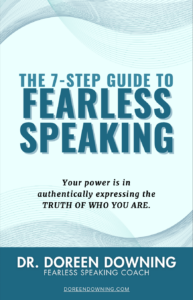
Get started now on your journey to your authentic voice by downloading my Free 7 Step Guide to Fearless Speaking: doreen7steps.com.
 Podcast host, Dr. Doreen Downing, helps people find their voice so they can overcome anxiety, be confident, and speak without fear.
Get started now on your journey to your authentic voice by downloading my Free 7 Step Guide to Fearless Speaking: doreen7steps.com.