
Today's Guest: Caren Carnegie
Today, I interview Caren Carnegie, who grew up shy and struggled to find the confidence to use her voice. As the youngest of three girls, her older sisters often spoke for her, leaving her little room to express what she was feeling and what she wanted to say.
For much of her life, Caren followed what was expected of her while struggling with her relationship with herself and her body. After an injury in 2019, she began exploring movement and discovered something unexpected about the way she communicated with herself.
That discovery led her to make changes in her life, listen more deeply to her body, and trust what she was experiencing. Along the way, she found the courage to share what she was learning.
Today, as the founder of Transform Fitness Coaching, Caren helps others connect with themselves through movement, nature, and spiritual life coaching. She shares how listening to the wisdom of our bodies can help us find our voice and discover new ways of showing up in the world.
__________________
Caren Carnegie is the founder of Transform Fitness Coaching, a speaker and writer whose work explores embodiment, the wisdom of the body, and storytelling through channeling.
Her work invites people to listen more deeply to what moves through and around them, and to consider how that awareness shapes the way we live, lead, and participate in the world. Caren is a fellow Torchbearer at IGNITE: The Inner Uprising, where she represents the wisdom of the body.
Watch the episode:
Connect with Caren Carnegie
Learn How to Speak Without Fear!

Also listen on…
Transcript of Interview
Transcript of Interview
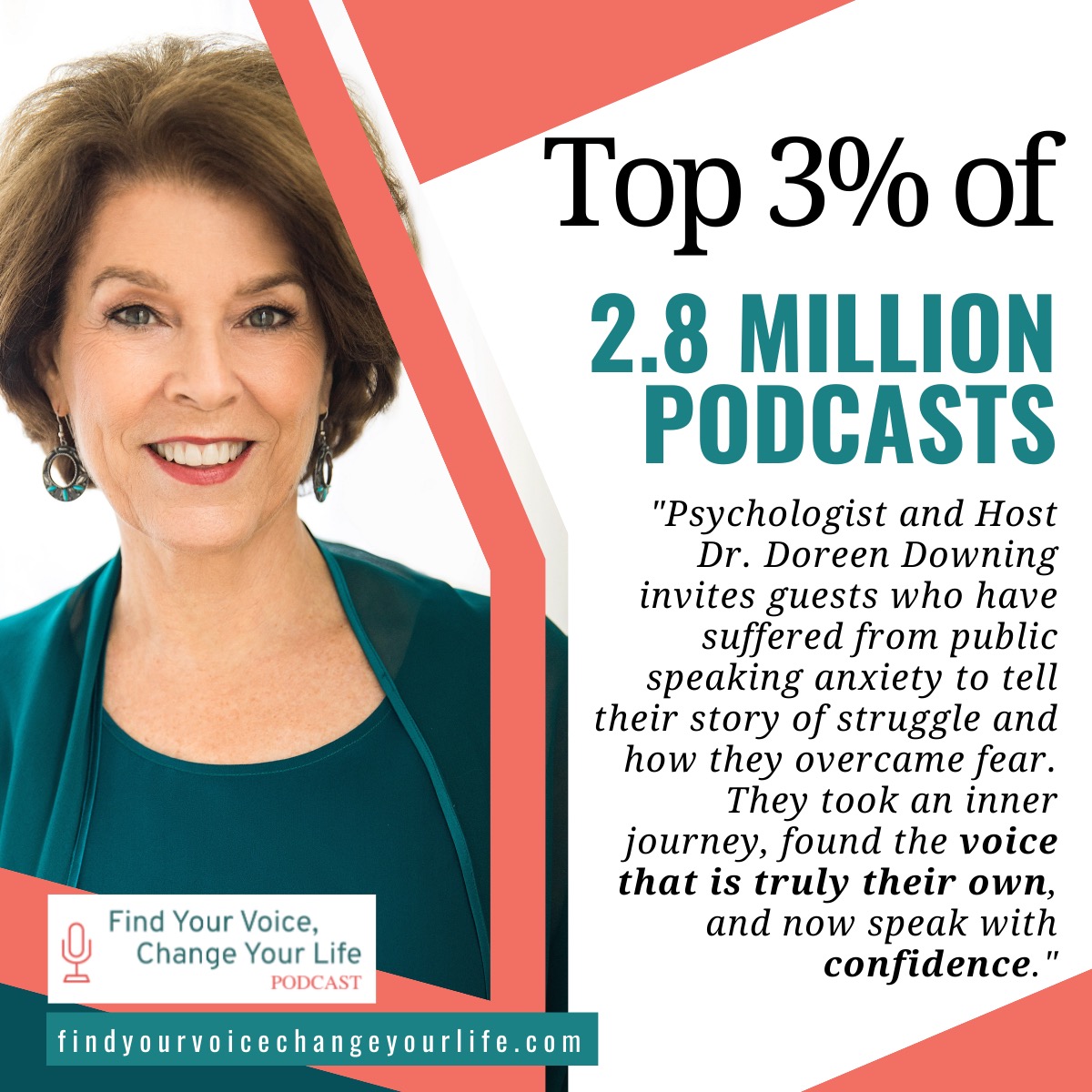
Find Your Voice, Change Your Life Podcast
Podcast Host: Dr. Doreen Downing
Free Guide to Fearless Speaking: Doreen7steps.com
Episode #193 Caren Carnegie
“Your Body Has a Voice. Are You Listening?”
(00:00) Doreen Downing: Hi, good morning. This is Dr. Doreen Downing, and I’m host of the Find Your Voice, Change Your Life podcast. What a wonderful opportunity I’ve had for so many years to interview people that I want to get to know better. I want to discover more about where they came from, what the struggle was around finding their voice, and having found their voice, or at least in the process of it, what they get to do now.
So welcome today, and I’d like to introduce you to my guest, Caren Carnegie. Hello.
(00:37) Caren Carnegie: Hello. Thank you, Doreen. It’s so good to be here.
(00:40) Doreen Downing: Yes. I feel like da-da, da-da, da-da. I don’t know, I guess it’s morning here, and I just opened the curtain, and here she is. Yes. But I do have something I’d like to read because it gives us a good snapshot of you.
Caren Carnegie is the founder of Transform Fitness Coaching, as well as a speaker and writer whose work explores embodiment, the wisdom of the body, and storytelling through channeling. Her work invites us to listen more deeply to what is moving within and around us, and to consider how that awareness shapes the way we’ve lived and how we have currently been living, leading, and participating in the world.
And in our conversation today, we’ll explore Caren’s journey from believing she needed certainty before speaking to trusting what she knows, while still leaving room for what she doesn’t. We’ll also talk about the conscious and courageous steps that have helped her speak more openly and spontaneously, allowing the land, the energy, and what moves through her to guide the way.
I love that intro. All of it, especially the way that it ended, about the land, the energy, the connection that you must feel towards not only what’s happening in your body, but what’s happening around you. Feels like that’s your message and your gift to us.
(02:31) Caren Carnegie: I often say the body that we live in and the body we live on are in constant communication.
(02:38) Doreen Downing: Yes. I got it. That was good. Here we go. Nugget number one.
My listeners today, if you’re watching, you’ll see what a bright smile Caren has, and the kind of energy that’s alive. So if you’re listening, you’ll probably be able to feel the radiance already.
So Caren, we often start with early childhood. You’re Canadian, right? And I’m down here in San Francisco, California, USA, and we get to have this conversation, and it’s all because of this opportunity we have, which is the internet.
So otherwise, it’s kind of sad. I never would’ve met you had this opportunity or this technology not existed.
(03:40) Caren Carnegie: It’s so true. It’s so true. I’m often very thankful for that because it just takes these barriers away so we can have these conversations and experience each other’s presence. Because you’re right, how else would we be able to do that?
(03:55) Doreen Downing: Right, right. And I know I’m going off on a different tangent before starting with your childhood history, but it just brought up this fact that how do we, on something like this, an electronic little box that you and I see each other, how is it possible that we can feel each other’s energy?
Isn’t that amazing?
(04:22) Caren Carnegie: It never ceases to amaze me, even though I think you and I can both relate here, when we do have a lot of faith in our limitless potential and the unseen. But this is just that tangible proof, if you will, that we can connect in this field that we share, and that is a beautiful, beautiful understanding.
(04:58) Doreen Downing: Yes. This now moment is deep, and it’s always deep if we are willing and open to tap into it, and that feels like already I’ve been doing that with you.
So speaking of deep, tell us a little bit about… And our topic is voice and finding your voice. Sometimes people land in their mother’s and father’s arms with, “Hello.” Not hello, but goo goo ga ga, and they already have a voice. They’re supported.
I don’t know anything about your history. What was it like? Do you have any stories about finding your voice as a young, young one?
(05:44) Caren Carnegie: So I grew up, I was born and raised in Thunder Bay, which is a city in northern Ontario. So if anyone’s familiar with the vastness of Canada, it’s very far north.
And I was the youngest of three girls. So I’ve got two older sisters, and they often spoke for me for a really long time. And I was very shy. You know what? I am very shy.
(06:15) Doreen Downing: Yes. Good, good.
(06:16) Caren Carnegie: I am.
(06:16) Doreen Downing: Claim it. Yes.
(06:18) Caren Carnegie: Yes. That part of me never went away, and that’s okay. And that’s okay.
But what it did offer me was the opportunity to feel more than I often shared. And I was very sensitive. Am very sensitive. And I didn’t have the confidence to use my voice until much later in my life. I was of the “life happens to me,” that I get what I get and I don’t get upset. And I moved around in that way.
But it was really when I discovered that my body had a voice that I had the courage to use mine, because it felt really important to share that message.
So I went about and used my voice enough to go through childhood, go through adolescence, following the mold. I think a lot of us can share a similar plot where we follow the mold of what’s expected into adulthood.
Worked in dental hygiene for 20 years, and that job was very one-to-one, obviously, right? It didn’t involve speaking in front of groups. It was sharing a close space with one other individual for a lot of my day.
And that taught me a lot about human connection and the importance of that, because not everybody enjoys going to the dentist, and I do understand that. So it was really using that empathy throughout that career for a long time, and then having the courage to speak up in an industry that’s quite large and can be a little intimidating.
It wasn’t until much, much later that I found that voice because my body showed me that wisdom.
(08:41) Doreen Downing: Great. I look forward to exploring more about that in just a few minutes. But looking back and getting a sense of your, first of all, the way you claim nowadays shyness, which sometimes in society, I know it’s a stigma. But now we are saying that that has so much empowerment, whatever shyness means.
But as a little girl, it’s the roots, it’s the beginning of how you are in the world, less comfortable in the spotlight. You have these sisters who take up space.
So what happens early on, I know, is that that’s where we start to practice ourselves, showing up ourselves or maybe even showing off ourselves. Some of us were showoffs when we were young.
And so not having that practice, I just want to say this to listeners, is that that then gets carried because you didn’t have enough opportunity, practice to use your voice early on so that the instrument, you, your body, it was familiar to you.
Does that make sense to you?
(10:13) Caren Carnegie: Absolutely. Absolutely. I think that it showed me that leadership doesn’t have to be loud, that I can lead in my own way. And while I learned to… I spent a lot of time in my body, that doesn’t mean that the relationship was one that was comfortable in a lot of senses.
It was a lot like relationships that we experience outside of us, too. It was one that involved a lot of learning through things that weren’t perfect. Will I regret anything? No. But again, it’s all things that have taught me so much about the relationship that I have with myself and my body.
And I think that growing up, everything just is so intentional. If it was any other way, I just don’t know if I’d be here talking about this right now. While things weren’t easy, I have the biggest smile on my face because it’s what it was showing me, right?
(11:33) Doreen Downing: Well, your approach to yourself, your life, your experience feels like that’s one of the benefits we’re getting today, is that lesson from you. Because so many people that I’ve interviewed here have… I mean, even though you were quiet and you were not actually using your voice a lot, just fitting the mold, like you say, and just doing what’s next in front of you to go through those phases, it still feels like…
I’m trying to say that the growth, what you look at now, you do not see it as anything other than life teaching you.
(12:22) Caren Carnegie: Yes. Yes. In every moment. I’m still getting teary-eyed about it, just how beautifully it has unfolded. And it’s so real.
It’s just stuff that you can’t learn. What my body has shown me, and what I learn now from the earth as well, the story has gotten very well connected in its communication. It’s just gotten scaled out a little bit to include the earth and how that all communicates with us as human beings.
I just couldn’t ever pick up and learn about this kind of stuff in a textbook. To be able to feel it and experience it and courageously speak about it, it really just brings it home, quite literally, how important it is.
(13:33) Doreen Downing: Yes. Home in many senses, home in the very core of us.
So let’s go to that point. You’re talking about the land, you’re talking about the earth, you’re talking about the outside and the inside. How did you… Was there a moment, or was there just a… You hear me going, “What the heck happened?” That you became somebody who really realized the wisdom of the body, of your body, that your body had something, had a voice, I guess you might say.
(14:13) Caren Carnegie: So it was in 2019 where I was really on a path of still abandoning myself in many, many ways, and abandoning my body and my health, and just really seeking things that felt easy and quick to feel better. And I ended up breaking my ankle in an incident that had involved drinking at the time, and that is something that I was doing a lot of.
But again, it’s not from a place of where I sit now, guilt or regret or shame or anything like that. It was just the place that I was in at that time. And my body wasn’t feeling well. I was very inflamed and in a state emotionally where it was just this cycle where I was regularly trying to escape how I was feeling, because this seemed like the scariest place to be was with myself.
So I ended up breaking my ankle and spending some time laid up because of that. And I had decided I wasn’t getting the answers that I was looking for from the doctor. There was nothing that could just take this discomfort away that I was experiencing. So maybe it was time to take a look at moving my body.
And in 2019, I had sought out a personal trainer because I didn’t have the knowledge of where do I even start with this? I had just injured myself. I was worried about injuring myself again. But I didn’t want to enter a gym alone without knowing what to do, because there was some fear around that.
So I reached out to a personal trainer at that time, and having that one-on-one guidance, I found that really, really helpful. And then the pause of 2020 happened in the world, and the gyms were closed. I don’t know if they were closed in the United States, but they were closed here for quite some time.
And so all of that traction that I had gotten there for a short period of time potentially could’ve just stopped. But I knew well enough that I wanted to keep going with whatever knowledge I had, with whatever I had.
So at home, we weren’t living where I live now, we were living in our previous home. I had set up a little area in the furnace room where we had really old, it was Jeff’s dad’s really old, remember that? Like Golden York equipment. But it was fine. It was fine. It was heavy. It was great.
So I used that and did what I remembered from my training, my short period that I had with the trainer, to keep that spark going.
But what I realized when I was alone and going through these steps on my own, that all of a sudden that conversation, that self-communication with myself, went from a lack of confidence to more motivating terms. It was something that I was learning and growing and doing on my own imperfectly, but I met myself where I was every day.
And all of a sudden, the communication that I was having with myself changed. And I took notice of that. It was enough to really, really notice.
And then I kept going, and eventually the gyms did open again. I went back to my training. Now, at this time, I was still drinking alcohol every day.
I had started moving my body, started opening that line of communication with my body, but emotionally and spiritually, it wasn’t even in my language at that time. I mean, it was always in my heart, it’s always in our heart, but it just wasn’t in my language at that time.
So it wasn’t until 2023 that I… It was going to be February 10th, 2023, that I stopped drinking.
A week before, I was visited by someone one night, and the presence just seemed very much bigger than anything I’ve ever experienced. And the message was, “Your work starts now.”
(19:40) Caren Carnegie: It was a week before. I didn’t know what that meant. I was like, “What do you mean?”
But I knew again well enough by how that felt and the way it was stated that something really important was about to begin. And it did.
(20:05) Doreen Downing: You’re feeling it now, huh? Yes.
(20:11) Caren Carnegie: And then I haven’t looked back. So then what started happening was that still through movement, I would consciously listen in to how my body was feeling, and then I started journaling it because I was like, “Okay, I don’t know why I want to write this down, but it feels important, so I’m gonna write it down.”
So then I started journaling some of these communications that I was having that I thought were with myself, and I think a lot of them were my higher self. And then I would start taking my movement outside.
(20:53) Caren Carnegie: And then that’s when I started experiencing ideas that were bigger than mine. There’s no way. This is… And it’s how actually Transform was created, through a walk I was having outside in, oh gosh, early 2022. I started making notes about this idea I was having. So looking back on them now, it’s really fascinating.
But again, I knew well enough that it felt important. I was gonna write them down. So when I had the message of “the work is starting,” I didn’t know what I needed to do. I just knew I needed to start taking notes, so that’s what I did.
And then as I would start reading these notes, going back to what I had written, I often say our best literature is our own literature. I would go back and read to find out that things… I wasn’t predicting anything, but things were lining up in such a fashion that it just couldn’t be discounted.
So that’s when I started realizing that it was in 2025, or maybe 2024, 2025, where finally my mind caught up and I realized what was happening, that I was channeling information from a field that doesn’t need a name or a label or any type of identity.
I was a part of something. We all are a part of something greater. Going back to how you and I began this conversation, how can we, through screens, feel so connected? Because we are sharing this field in the now moment.
(22:46) Doreen Downing: Yes.
(22:47) Caren Carnegie: While we can’t predict things that come next, we can certainly share a feeling of the moment we’re in now.
(22:55) Doreen Downing: Yes. And before we go on, I need to take a break. We like to let listeners know it’s an opportunity for them, and we’ll be right back to continue this fascinating journey, walk through not just your life, but what others can learn from you. We’ll be right back.
Hi, we’re back with Caren Carnegie this morning, and already today what I’ve been touched with is the power of her presence, which is not only what she’s saying, if you go back and listen to the golden nuggets that she shared, but also just what is happening between us. That there’s a shared life moment we are having right here, right now.
And something is emerging from Caren, a message that’s something that she’s not only experienced in her life, but has been guided to share it out. And that’s why we’re here today on this podcast, so that we give Caren a platform for her to share her message about how her body, how something intuitively, that’s just the word that I’m picking right now, she listened. She learned to listen to something that was appearing for her, and I guess heeded the message.
(24:38) Doreen Downing: So there you are learning about, I mean, you’re picking up weights or something, and it becomes not just strengthening your body, doing muscles, getting toned, becoming healthier. It was so much more, wasn’t it?
(24:57) Caren Carnegie: I learned that we were so much more than physical bodies. That we were energy. That we were things moving. That our emotions were energy as well, and that’s why people will… And it says behind me, “Move with what moves you,” because who are we to tell our bodies to move the same, to push when things feel uneasy?
There are things, and understanding the energy that flows through us and to us, that’s surrounding us as well. There’s times where we just can’t explain, but we feel like a wave is crashing against us. So understanding that just helps me to understand myself, and that it was okay to move with the current, to move with my emotions, to change what I was doing if that felt right.
While I would always move, it didn’t always look the same. Our soul is expressing itself through these bodies of ours. And for some people, that looks like movement. For some people, it looks like art. For some people, it looks like watercolor. It is our soul expressing itself, and it doesn’t want the same thing.
It might just want us to listen and to be curious about what that might be for us.
(26:31) Doreen Downing: So what you’re sharing with us, because where we started, or what I said, was Transform Fitness, and what we’re talking about is how we as a body, it’s almost like a body, self, and soul is fit. It’s not just muscles and strength and flexibility.
(26:52) Caren Carnegie: Exactly. So I actually changed the word fitness to be fit-ness, because to me, fitness isn’t an industry. It’s not a thing we do. Fitness, to me, is a state of being. Fit-ness, hyphenated, is about feeling sound in here so we can feel sound out there.
(27:14) Doreen Downing: Yes. You must feel wonderful lining up with this message, which, of course, goes against an industry that really, I was gonna say, preys on our self-images and what people tell us is good about being healthy. And I love deepening and expanding what that actually means, fit, and the whole idea of what you just said.
It’s about the being of you. It isn’t about how many muscles you have.
(27:58) Caren Carnegie: Yes. And how could one not keep their momentum going knowing that, right? That we don’t need a thing, that we already have what we need right here. This is the best piece of equipment we will ever have, is this.
And while I work with people out here, we lift logs, we move logs, we press against the ground, we do wall sits against a tree, we tree sit. We include nature in what we’re doing. We have a space inside that we use as well.
But again, anything done with intention is done well. And so, is our intention to do something because we feel like we should, or is it because of deepening that bond that we have with ourselves through the body?
The body is what takes us to those things that we desire. And it always forgives. The body, it really… When people, you can just notice when people’s eyes light up when they do something that feels good, that maybe they would have told themselves they couldn’t.
That is one of the, if I could bottle that up, it is just one of the best feelings and sights to see.
(29:44) Doreen Downing: The breakthrough. The yes that could live inside once they get… And that’s partly what you do, is guide them to it.
So when you started talking about the actual exercises, I think that for our listeners, that became more real about how you actually help people tune in and listen to, but also I would suppose to come to know themselves better, but also do, I’m putting quotes around it, air quotes, “exercises”?
(30:19) Caren Carnegie: Yes. Yes, if we call them that, yes. I find the body is a bit of a storyteller, and through your years of clinical practice, you may have picked up on that with body language, say, for example, and how people present anywhere. How we arrive anywhere, right? We don’t always arrive in our bodies.
We arrive maybe here, which is fine, but we arrive here, and then there’s some language associated with that perhaps. So as people begin to move, their body starts to tell a story.
Now, I am a spiritual life coach as well, so I do this through movement. Also combining conversation is really important too, because energy… Just the movement and listening and talking and allowing those things to flow freely is a really powerful conversation.
But then you’ll start to see people, all of a sudden, maybe we present a little bit contained with our body and within our energy because we’ve just come from a meeting or maybe we’re just feeling a little bit like our nervous system isn’t as regulated as we’d hope.
But then as they start to move and that energy begins to move freely without obstruction, all of a sudden their arms are going into these beautiful lateral raises, and I’m watching them, and it’s like they are becoming like birds, just eagles flying, wanting to take up space, knowing that they aren’t contained in that field that maybe they presented feeling that way.
It happens to all of us, right? And that’s okay. That’s okay. But just through those movements and that conversation, and allowing these things to move, to not disappear. I mean, we can’t arrive somewhere and then shut things off. We allow them the space to finish speaking. I think that that’s really important here.
When we’re talking about speaking, I think it’s fair to allow our minds to finish speaking, too, and allow those thoughts to finish, and then have the space to move. And then people leave feeling more like their body and their heart and their mind are leaving walking together, when maybe it didn’t feel like that when they walked in.
(32:56) Doreen Downing: That’s a perfect description about the alignment of body, self, and soul. Their heart, their mind, and their actual feet. The toes. Everything. The toes and fingers and spine.
Caren, that sounds like a lovely experience. How do people find you if they want to get close and have some work with you?
(33:24) Caren Carnegie: So my website, transformfitnesscoaching.com. And I do fitness coaching virtually, but I also offer spiritual life coaching as well. And talking of the body is always included in all of our stories and conversations.
Instagram @karencarnegiefitness, Facebook Transform Fitness Coaching, LinkedIn at Caren Carnegie.
I write articles. I love to write, and way back when I started all of this, I knew it was important to start taking notes and writing things down. I still do that. So I give them a place to live out in the ether.
So I write for Brains Magazine. I write blogs. I’m constantly writing because it helps me process ideas and this information that gets out into the world about how important these bodies of ours are. And the body that we live on, too, is always mirroring things back to us. It’s about paying attention.
(34:33) Doreen Downing: Yes. There you go again, the body that we walk on, and not only the body we walk in, but having awareness that this is a relationship that is ongoing. And let’s open ourselves more to being connected, I think, is another word I’m taking today with you. The full connection of what is and then what can be.
And it seems like your work in opening people to more of what can be in an alignment way that you’re talking about, what you just said.
Well, thank you for opening up your own journey and giving us insight into how you help people find their voice so that they can change their life.
Thank you, Caren.
(35:30) Caren Carnegie: My pleasure. Thank you for having me.
Also listen on…
 Podcast host, Dr. Doreen Downing, helps people find their voice so they can overcome anxiety, be confident, and speak without fear.
Get started now on your journey to your authentic voice by downloading my Free 7 Step Guide to Fearless Speaking: doreen7steps.com.
 Podcast host, Dr. Doreen Downing, helps people find their voice so they can overcome anxiety, be confident, and speak without fear.
Get started now on your journey to your authentic voice by downloading my Free 7 Step Guide to Fearless Speaking: doreen7steps.com.