
Today's Guest: Aleya Harris
Today, I interview Aleya Harris, an award-winning keynote speaker and former Google executive, who grew up as a natural talker but became self-conscious when people focused their attention on her. A comment from an adult relative stayed in the back of her mind for years and made her question herself whenever people were watching her speak.
As a teenager, Aleya finally stood up to that same uncle and describes the moment as reclaiming her voice. Later, postpartum depression challenged her identity in a different way and gave her what she calls an “earned gift” of empathy.
Today, Aleya helps leaders and speakers uncover the stories they have lived, recognize the lessons inside those experiences, and shape them into something they can say with clarity and conviction. Aleya believes that everyone has something to say, stories to tell, and a legacy to leave, and that no matter what you have been through, your experiences can become part of what you offer to others.
__________________
Aleya Harris is an award-winning keynote speaker, former Google executive, and Founder & CEO of The Evolution Collective. As the creator of the Story-Driven Leadership™ framework, she helps leaders, entrepreneurs, and organizations find their authentic voice, build trust, and inspire meaningful action.
For more than 15 years, Aleya has empowered people to communicate with confidence, lead with purpose, and transform the stories that shape their lives, careers, and leadership.
Watch the episode:
Connect with Aleya Harris
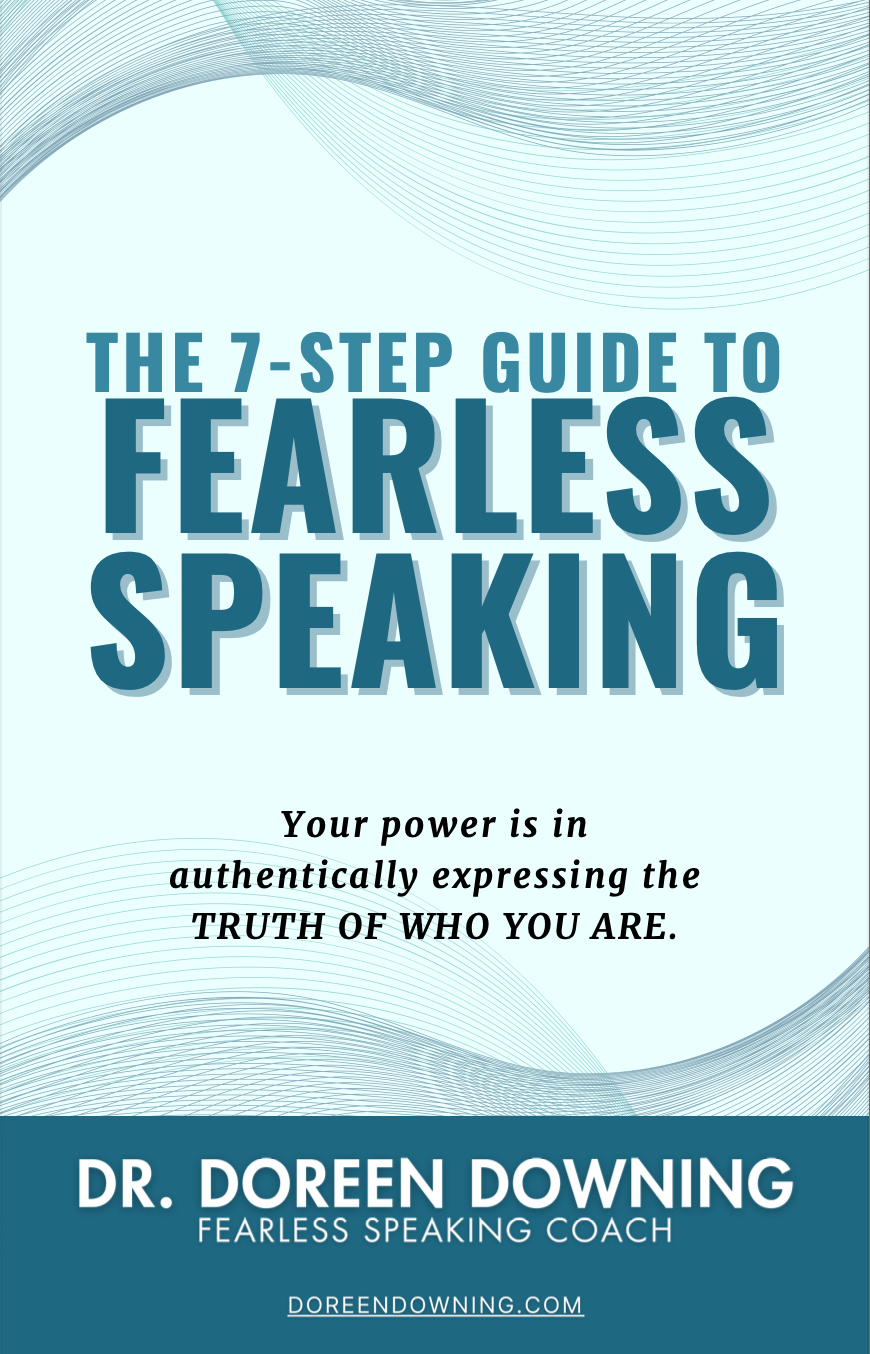
Learn How to Speak Without Fear!

Also listen on…
Transcript of Interview
Transcript of Interview
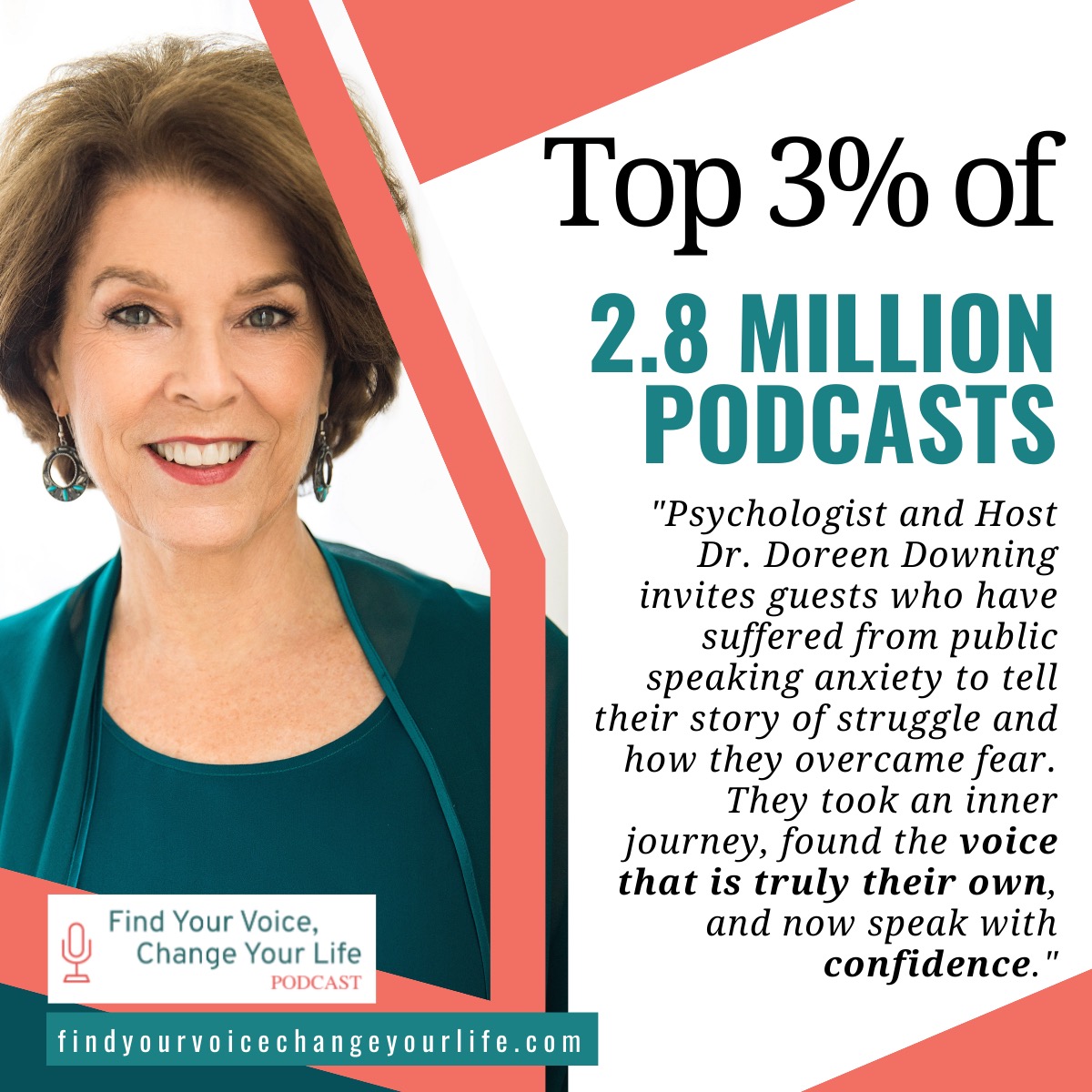
Find Your Voice, Change Your Life Podcast
Podcast Host: Dr. Doreen Downing
Free Guide to Fearless Speaking: Doreen7steps.com
Episode # 192 Aleya Harris
“From Pain to Purpose, From Voice to Power”
(00:00) Doreen Downing: Hello, this is Dr. Doreen Downing, host of the Find Your Voice, Change Your Life podcast. I get to introduce my listeners to people who have, at some point in their life, felt like they either didn’t have a voice or lost it.
And today, you’re going to be meeting somebody that I am just getting to know, so this moment of saying hello to Aleya is brand new to me, and it’ll be brand new to all of my listeners today. Hi, Aleya.
(00:35) Aleya Harris: Hi there. Nice to be here with you. I’m very glad.
(00:39) Doreen Downing: We get to jump into a conversation getting to know each other, and I know from some of what I’ve already read about you that you didn’t always come out saying, “Hello, world. Here I am. Look at me. Look at me.” Your voice didn’t have to be something that was already formed, because it wasn’t.
And what I read is that earlier you thought it had to be perfect, and I know that’s one of the things that weighs on people. How do they look? What’s their image?
And I have some notes here. Early in your career, you thought the way to prove your value was to stay quiet, work harder, and wait for others to recognize you, but you eventually realized that your silence was not protecting you. It was limiting your ability to lead, connect, and create change.
And I’d like to honor you today because you’re now an award-winning keynote speaker, former Google executive, and founder and CEO of the Evolution Collection. And you’re also the creator of Story-Driven Leadership, which is a framework through which you help leaders in organizations find their authentic voice, build trust, and inspire meaningful action.
And wow, speaking on international stages, encouraging leaders to stop worrying about saying the right thing and begin saying the true thing. I’m so glad my listeners get to meet you today.
(02:33) Aleya Harris: And I’m glad I get to meet them. Thank you. That’s so wonderful of you to say.
(02:38) Doreen Downing: Yes. Well, I already feel little shivers on my body when it gets to be real, the conversation. Wow.
So, usually we like to start early in life. I’m a psychologist, and I get curious about what people’s early journey was. How did they come into this world, and how were they welcomed, and what happened early on?
So if you have any stories about that.
(03:08) Aleya Harris: Yes, absolutely. Well, I remember one of my first memories about my voice was elementary school, young elementary school, like first grade, second grade, something like that.
(03:27) Aleya Harris: Being always told to be quiet because I talked a lot. I talked to my neighbor who was sitting next to me. I wasn’t loud, but I didn’t really know how to whisper necessarily.
And then I was also a smart kid, so I grew a little older, and I was the one always raising my hand. And then the teacher would be like, “Well, let’s see if we can hear from somebody else today in class.” And what that did was make me feel like speaking and speaking too much or too loudly or to too many people was not good.
I wasn’t supposed to use my voice to stand out in any way because it clearly made people uncomfortable. So what I should do instead is stay a little bit more quiet. Now, I was never a silent, quiet child. There was never like, “Oh, I’m so shy.” That was never it, but I never saw speaking when I was a child as something super positive.
And I remember this one Thanksgiving dinner, I believe it was. So every Thanksgiving dinner, we would get together at my grandparents’ house, and I have a very small family. So I was probably maybe seven or eight at the time, and so was my grandmother and my grandfather. My grandfather’s brother, who is the problem in this story, he is the protagonist, or the antagonist. And then his wife, my mom, her one sister, and maybe a cousin or two. That was it. That was the whole table.
And I remember I was talking about something and the whole table was looking at me, and for some reason I looked and I said, “Oh wait, why are you guys all looking at me?”
And I remember my great uncle, who I did not enjoy then, and he recently passed away so I guess I shouldn’t speak ill of the dead, but never really came to enjoy as a human, said, “Well, when everybody’s looking at you and you’re talking, it probably means you’re saying something you shouldn’t be. So you should just pay attention to what comes out of your mouth.”
First of all, my mom was livid. She said, “That’s not what that means,” and I remember hearing her stand up for me, but the damage had already been done. I was talking, people were looking at me, that must mean that it’s bad, so now when anybody’s giving me their undivided attention, that must mean that I’m saying something wrong.
(06:28) Aleya Harris: And it took a while to get over that. It’s so funny how certain moments that are fleeting for some are core for others.
But I think that because I am a natural-born talker, I just kept talking. Not necessarily in those situations, because I did become self-conscious, but then I remember, fast-forward, I was probably 16 now, so about eight-ish years later. Same uncle, and he said something.
And in my family you say, “Okay.” I mean, some people can say something crazy, your elders say something crazy and you just say, “Okay,” and let it brush off. But he said something and I couldn’t stand it anymore.
(07:32) Doreen Downing: So that was the beginning of speaking back to somebody.
(07:37) Aleya Harris: Speaking back and dismantling his opinion of me.
Because as I was going through those years, I would, for better or for worse, not even for better or for worse, for worse, hold that comment of his in the back of my head and be like, “Ooh, people are looking at me. I must be saying something wrong.”
And when he said something, everybody was somewhere in the kitchen, somewhere in the living room, but I started talking to him. Well, I would love to say that it wasn’t disrespectful, but yes, no, it was. I wouldn’t even cuss him out or anything, but I said, “No, you can’t talk like that. That’s wrong. Why are you saying…” And his eyes got as big as saucers because that’s not what we did in our family.
And it felt like in that moment I reclaimed my voice. I reclaimed the thought of, well, when someone was looking at you, you must be saying something wrong. Because when I was talking to everybody, they were all over in different parts of the house, but you better believe that they all came right to the kitchen where I was talking to my great uncle, and they were all looking at me, and I didn’t give a damn.
(08:54) Aleya Harris: Because I was done hiding, done letting his opinion of me, that one-off comment, control how I showed up in the world, and I was done letting him just talk all willy-nilly to people. I did not enjoy it. And then afterwards, my grandfather just gave me a look, and my mother pulled me over and told me how proud of me she was.
(09:16) Doreen Downing: Oh, to get that affirmation. Yes. That moment early at the table to me feels like why it was more. You talk about some people having experiences that just pass through, and others that penetrate more.
And that penetration of that sense of yourself in that moment feels like there’s shame, and that to me is what my listeners are probably taking from the story you just told, the feeling of being shamed in public.
(10:01) Aleya Harris: I could never. I could never.
(10:05) Aleya Harris: I guess I’m still riled up about it.
(10:08) Doreen Downing: Well, I’m glad because that will help my listeners go, “Let’s get riled up.” If they haven’t yet had a breakthrough moment like you talk about years later with your granduncle, they need to start looking for ways in which they can claim. You just stuck your body, your voice, your backbone into the ground and said, “This is who I am. Back off, fellow.”
(10:41) Aleya Harris: Exactly. Exactly. Not only back off, but back off of me and back off of everybody else.
(10:48) Doreen Downing: Yes, yes. Well, the declaration, it feels like, was a moment for you. In this podcast, people talk about those moments of breakthrough. Yours was pretty early.
(11:06) Aleya Harris: Yes, and I think that’s because of natural gifting.
So I will talk about gifts. Some gifts you earn through hard times, and some you are born with. And your born gifts are the ones that are the easiest for you to ignore or the easiest for you to feel like something’s wrong with you. It’s very interesting.
Usually people are like, “Oh, yes, well, I talk a lot, so I’m so sorry.” And it’s like, “Yes, no, you talk a lot. That’s great. Use your power of communication.”
Or like, I’m tall. I know you can’t necessarily tell from looking at me now because you just see me from the shoulders up, but I’m 5 ’10”. And my mom always made sure to put me in dance, to tell me how wonderful it was to be tall, et cetera, et cetera. She’s 5’5″.
So I never saw it as being something that was a problem, but always a benefit. But it could have very easily gone the other way because she saw tall women that walk hunched over. Every step is them apologizing for taking up space.
And my mom, she’s like, “I refuse. I have a tall daughter. I refuse to have this be her story. She’s not gonna walk all hunched over.” And I said, “Yes,” and I don’t.
And that was because she helped me see early on that something that was unique about me was actually a gift.
I have lots of earned gifts, deeper senses of empathy, being a really good writer, being a really good chef. I went to culinary school, right? Those are earned gifts. Maybe you have a little bit of a talent in the beginning, but it’s not super obvious, right? You gotta work for that.
(12:56) Doreen Downing: So the earning means you’ve trained, like going to culinary school.
(13:00) Aleya Harris: You’ve trained. Well, yes, trained going to culinary school, but it could also mean, like, the empathy that I earned for people that basically can’t see which way is up, down, left, and right, I earned that through deep postpartum depression. I earned that empathy.
(13:19) Doreen Downing: I’m gonna have to go there.
(13:21) Aleya Harris: Yes, we could totally go there. And I go there in my book, and I talk about it all the time because, for me, you can go through something, and that is painful. And that sucks. And you can go on the other side of it. But it’s even better if your pain has a purpose. And that purpose should be to teach you something. But the grander, grander purpose should be for you to help someone else find their way through.
(13:55) Doreen Downing: Oh, well, that’s what this whole podcast is about, Find Your Voice. I had my own difficulty with stage fright, and here I had a PhD in psychology and still was able to hide that I had this terrible, crippling condition that held me back.
And so you’re right about that. I just love that concept. I’ve never really heard about it. So listeners, earned gift, meaning whatever experience that you’ve had, instead of holding it as, “Oh, too bad for me,” it’s like, “What did I learn? What can I then pass on to others just by the journey that I took?”
(14:44) Aleya Harris: Yes. What did you learn? What can you share? How can you be of service? Because then it’s all worth it. Before then, it’s just pain. But after that, it was a gift.
(15:03) Doreen Downing: But you had to process the pain. You had to be in the pain.
(15:08) Aleya Harris: You can’t spiritually, what do they call it? Spiritually, not circumvent.
(15:13) Doreen Downing: Right.
(15:14) Aleya Harris: Bypass. Spiritually bypass. Good. You got it. You can’t spiritually bypass.
(15:19) Doreen Downing: Yes. Before we move on, because I think this is so rich about the how-to, if you are having something that’s bringing you down, suffering, for me, the people that I work with have stage fright or public speaking anxiety. How do you move through it? And of course, those of us who are guides help people to work through it. But what helped you?
(15:52) Aleya Harris: To work through which part?
(15:54) Doreen Downing: The postpartum depression.
(15:57) Aleya Harris: Girl!
(15:58) Doreen Downing: All the things.
(16:00) Aleya Harris: Learned empathy. All the things, girl. I have a scaffolding system happening at this point in time. So let me begin enumerating them for you. One was therapy. The first was also group therapy, but I only did a couple of sessions, and it didn’t help in the intended way. The intended way is, “Let’s kumbaya. We’ll see.” The real thing that happened was I’m like, “Y’all got it a lot worse than I do. Thank you so much for playing.”
(16:28) Doreen Downing: Yes.
(16:30) Aleya Harris: While I might have postpartum depression, I don’t have to worry about that mother-in-law that you’ve got who’s being nasty, or your husband never being at home. They had other issues also to deal with. Right? And so I was like, “Okay, let’s put this in perspective. I actually have a lot more tools and a lot more support than I thought I did.” Then there was therapy, medication.
There’s also a lot of internal-based tools, like ideal scene crafting and visualizing, forgiveness work, yoga, and somatic body work to release anger and resentment. And sleep was also quite important. I took it upon myself to not stay where I was.
And that’s the lie of depression, that it always has been there and always will be there. And right now, in the present, it is here, and the present feels nebulous. Like, when did the present start? Am I in the present now? All I know is that this sadness has always been this frenemy for as long as I can remember, and it robs you of the power to choose anything besides it. So the first act of rebellion on my part was to choose to keep moving forward through the fog. Because when you are standing still, you have a 100% chance of not improving.
(18:20) Doreen Downing: That’s true.
(18:21) Aleya Harris: When you’re moving forward, you might be walking in the wrong direction, but at least you’re moving. You might walk straight into a wall, but at least now you know where that wall is. You turn around and you try another direction, right? You’re feeling out the space as long as you stay in some type of movement in your life.
(18:41) Doreen Downing: These are such wise nuggets here that you’re passing on to the listeners. And I know we’re talking about depression, and I also know that it’s your journey, and I want to relate it to public speaking anxiety. It’s the same message that I feel like you’re giving to people who have public speaking anxiety. This whole idea of, “Well, I’ve always been shy,” or “I’ve always avoided,” “I’ve never been good at,” this kind of identity, this self-definition, and yet they’re suffering. They can’t move on in their careers, or they can’t express the love they have at a wedding or at a funeral. And it’s just so many ways in which the doors are closed. Those walls that you talk about are right up against their nose. And so that keeps moving, and then I guess coming back to what you said and trying to relate it to my listeners is the choice. You do have a choice.
(19:48) Aleya Harris: Yes, yes, yes. Absolutely. You do have a choice. Yes.
(19:57) Doreen Downing: Well, I’m going to take a quick break because there’s more to share, I know, Aleya, with already the bright light that you are and what you’ve learned, and your beautiful confidence that’s coming through very clearly. Thank you. Just a minute. We’ll be right back.
Hi, we’re back now with Aleya Harris, somebody that I am enjoying tremendously getting to know because she’s a wisdom carrier.
(20:34) Aleya Harris: Thank you.
(20:35) Doreen Downing: Because she’s had life experiences that have taught her, and she’s been able to, well, I could say process, that’s kind of a psychotherapy word, but she’s been able to… The word is transform. That’s it. You’ve been able to transform life experience and make something purposeful, meaningful out of it. So thank you.
We’re back now with continuing the journey of you. We’ve talked about some of your early life and the breakthroughs that you had, the declarations of, “I am who I am,” and you’ve also somewhere along the line decided that you could, with your empathy, your earned empathy, help others. So let’s talk more about how the journey has led you to be who you are today, international speaker, keynote, book writer.
(21:38) Aleya Harris: All of the things. Yes, all of the things. I’m sure I could have done things without getting that deep empathy, but I would not have been as effective.
Before some of the things that I’ve gone through, I had gone through things, but nothing that took me out, had me question my identity, question what was important to me. And so I was able to better relate to my clients because of what I had gone through. I could understand what it was like to feel lost, to lose the thread of your own story, to feel like you weren’t fit for human consumption, right?
See, I understand what it’s like to not know what to say. You’re supposed to say something, even to introduce yourself, you’re like, “Well, who am I? What self do I want to put on? Well, I guess I better mask it.”
And then I also know what it’s like to get back to that radically authentic self, celebrate yourself for it, be celebrated for it, and eventually build a body of work around how to communicate that on an individual and an organizational scale.
And so because of that journey, when clients come to me, there’s no judgment. There’s just, “I get that. Yes, I feel you on that.” And then there’s a lot of tough love, like, “Yes, I feel you. Just because I feel you and understand you doesn’t mean I’m going to let you stay there. And I have all the empathy for you, but that’s also why I’m like, let’s keep… Like I said before, let’s keep it moving. Let’s keep pushing.”
One of my superpowers is pattern recognition. So I’m able to see a deeper set of patterns now because I’ve gone through a deeper set of pain. And that pain has allowed me to treat people also, I know it’s supposed to be the opposite, but it allows me to treat people less fragilely.
So when you see a pain or a hurt that you don’t understand, you’re like, “Ooh, I better hold this person with kid gloves because I don’t know how much pressure they’ll take before they pop.”
For me, I’m like, “Yes, dude, I get it. You went through this, this, and this, and I’m so sorry. However, I also know that you’ve got enough love to give, and I also know that you can get back, and I also know…”
It allows me to get to that real place and speak love into them in a more direct way because I know that just because you’ve gone through deep pain doesn’t mean you’re fragile. It just means that you haven’t spoken into the part of you that needed to hear how strong you were yet.
(25:03) Aleya Harris: And if I can do that for others, then I’m doing my job.
(25:05) Doreen Downing: That’s what I’m hearing, is that you are like a witness or somebody, like a mirror. You’re able to say back to them what is inside that they haven’t heard themselves say, like what you just did. You got this. Not only you got this, but look at how brilliant you are.
And I know that in my work, I call that essence appreciation because I go to find the core essence inside. I know you talked about superpower. That’s another way to talk about it, but that kind of awe of what’s possible and what you see inside of people.
As somebody who’s a mentor, that’s how I get to feel when I witness inside of them beyond all of their self-doubt and worry. And they don’t believe it yet, but the more we see it and mirror back, I think they start to go, “Oh, maybe.”
(26:11) Aleya Harris: Yes. Exactly.
(26:16) Doreen Downing: Well, anything else about the work that you do you’d like to share around, let’s say, if we can pinpoint it towards speaking, speaking and voice?
(26:25) Aleya Harris: If we’re talking about speaking, which, by the way, I’d like to add a little asterisk, everything I do, whether seemingly or not, is talking about speaking, even if it doesn’t seem like it, I promise, because speaking is not just the ability to have words come out of your mouth in a pleasant way.
Speaking, when you’re speaking from a stage, is about having something to say. And if you don’t know yourself, recognize yourself, recognize the pain, recognize the lessons, recognize how you can then help somebody else through it, you don’t have anything to say.
And everyone has something to say. Every single person has stories to tell, legacy to leave. Every single person. That’s one of my core beliefs. The challenge is that you might not feel like you do because you haven’t done the work to unearth and codify what those stories are, and that’s what I help people do.
The other thing is, going back to the very beginning where you were talking about perfection and how I felt like I needed to be perfect, and I’m still a Virgo, so that’s not going to go all the way away.
(27:38) Doreen Downing: No wonder. So am I.
(27:41) Aleya Harris: When’s your birthday?
(27:42) Doreen Downing: Our birthdays are coming up. October 24th is mine.
(27:47) Aleya Harris: Yours is coming up. Mine is September 19th, and I’m turning 40.
(27:51) Aleya Harris: It’s a milestone birthday. I’m very excited about it.
(27:54) Doreen Downing: Good. I’m about 4 years ahead of you.
(28:00) Aleya Harris: 78. Wow. That’s amazing, by the way.
(28:02) Doreen Downing: It’s a great life. You’ve got a lot of good life yet to live.
(28:06) Aleya Harris: I am excited about it. I’m excited about it.
(28:12) Doreen Downing: Perfection. Everything’s about voice, you’re saying.
(28:15) Aleya Harris: Everything is about voice, and then we were talking about perfection, and I thought that I needed to be perfect for everything, and I still, again, might hold some of that to be true. But what I realize is that speaking is not about perfection, and needing to be perfect, needing to have it all down when you’re on stage, is actually the thing that gives you the most stage fright.
Because what that is, is you’re already judging yourself and pre-judging yourself for other people. So there’s just 360 degrees of judgment right there. It’s judgment all around. And you’re like, “Well, but I have to be perfect on this stage. My clothes, my slides, my voice, my this, my every…” Whatever your thing is that you’re afraid is not going to be perfect, you have to magically make it perfect on stage, and that is not true and also impossible.
Because my definition of a speaker is a performance artist who delivers helpful information from the stage. The key is helpful information. I don’t care what your slides say. Helpful information is what is helpful for who is in that room right now with their butts in seats. And unless you are clairvoyant, you don’t know that. You don’t know who’s going to have their butts in the seats until you are on that stage.
And so you’re never going to be perfect unless you decide to channel. And so this is what I teach to all of my speakers, which is why 80% of learning how to be a speaker happens off the stage, not, has nothing to do with that.
Whether you believe in a higher power, whether you believe in your highest self, whether you believe in the great donut maker in the sky, I don’t really care. I just need you to know that there’s a wiser part of you that connects to all of the other wise parts of everybody else.
And so if you’re listening and you’re in touch with your intuition, God, Allah, whoever, when you’re off the stage and you practice that muscle, when you’re on the stage, perfection is attainable, not because of how you look, not because of your slides, but because you will be able to adjust and shift the room based on what those butts in seats need right then to participate in their own transformation, which is the entire purpose of speaking.
You are there not so that people can see you, and I know it’s confusing, I get it. You’re the one with the cute outfit and the lights. I get it.
(30:51) Aleya Harris: But you are there to help someone else participate in their own transformation.
And the only way to do that is if you channel intuitively what they need based on your content. So that might mean you need to hold more loosely your own concepts, your own slides. Keep your slides simple so you can switch in and out stories. That’s why you need to know the frameworks of speaking and storytelling so that you can be of service for everyone’s highest good.
(31:24) Doreen Downing: Right.
(31:25) Aleya Harris: It also really helps the stage fright because then you let go of, “I know I’m not going to be perfect.” That’s literally impossible, but what I can do is meditate and visualize every day so I can get in touch with myself and work on being in the present so I can be in the present on that stage, so I can be of use to this audience.
(31:43) Doreen Downing: That’s exactly what I am all about, is listening to the listening, is what I call it. So it sounds somewhat like what you’re talking about, the relational presence, being so present in the moment that you’re connected to yourself, but you’re connected to everybody else. And that’s what’s primary, is that connection, because that’s what you’re transmitting so that there is transformation.
(32:13) Doreen Downing: This has been wonderful. I feel like I could talk all day with you and co-lead workshops with you. This is wonderful getting to know you, Aleya.
(32:22) Aleya Harris: I’ve loved getting to know you, too. Thank you for having me.
(32:24) Doreen Downing: Yes, yes, yes. Well, we’ll have show notes and we’ll have ways in which people can get to know you, but if they’re just listening, what’s the easiest way to find you?
(32:35) Aleya Harris: The easiest way to find me is go to aleyaharris.com, and you have free resources there, and I’d love for you to schedule a call if you’re interested in working with me. That’s A-L-E-Y-A H-A-R-R-I-S.com. And if you’re wanting to be on the stage, if you’re wanting to bust through that stage fright, if you’re wanting to figure out what to say and also how to make money from it, then I’m your girl.
(33:00) Doreen Downing: Wonderful. What an honor, what a pleasure, what a lot of fun today. Thank you so much.
(33:08) Aleya Harris: Thank you.
Also listen on…
 Podcast host, Dr. Doreen Downing, helps people find their voice so they can overcome anxiety, be confident, and speak without fear.
Get started now on your journey to your authentic voice by downloading my Free 7 Step Guide to Fearless Speaking: doreen7steps.com.
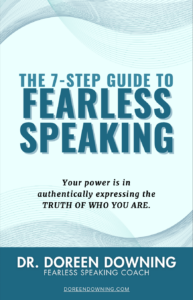 Podcast host, Dr. Doreen Downing, helps people find their voice so they can overcome anxiety, be confident, and speak without fear.
Get started now on your journey to your authentic voice by downloading my Free 7 Step Guide to Fearless Speaking: doreen7steps.com.