Today's Guest: Kayla Middleton
Today, I interview Kayla Middleton who spent much of her life speaking up for other people while finding it much harder to speak up for herself. Growing up in the UK, she was outgoing, expressive, and often seen as the responsible “good girl,” yet years of bullying and expectations shaped how she saw herself.
As she moved into adulthood, Kayla found herself settling for a life that felt limited. She believed struggle was simply part of growing up and that the “good life” was meant for other people.
In our conversation, Kayla shares the turning point that challenged that belief and helped her realize she could choose differently. What began as a practical decision to change her circumstances became a deeper shift in how she saw herself, her voice, and what was possible for her.
Now, Kayla no longer believes she has to settle for the bare minimum. She has learned to stand up for herself, trust her own choices, and give herself permission to build life on her own terms.
__________________
Kayla Middleton is an Identity and Mindset Coach for women in service-based businesses. She helps women stop being their own ceiling in business by identifying the beliefs, patterns, and behaviors that are keeping them stuck.
Through one-to-one coaching, her membership, and other resources, Kayla helps women understand what is happening beneath the strategies they are already trying to follow. Her work focuses on helping them shift their identity and mindset so they can show up differently, make decisions with more confidence, and move their business forward.
Having coached hundreds of women, Kayla is passionate about helping business owners get out of their own way so they can create not only the business they want, but the life they want that business to support.
Watch the episode:
Connect with Kayla Middleton
Learn How to Speak Without Fear!
Also listen on…
Transcript of Interview
Transcript of Interview
Find Your Voice, Change Your Life Podcast
Podcast Host: Dr. Doreen Downing
Free Guide to Fearless Speaking: Doreen7steps.com
Episode #190 Kayla Middleton
“The Courage to Stop Settling for Less”
(00:00) Doreen Downing: Hi, this is Dr. Doreen Downing. Welcome to the Find Your Voice, Change Your Life podcast. Every time I get to meet somebody new and introduce you to a person who might have struggled in a way that you struggled, this is what’s going to happen today.
This is my first conversation with Kayla Middleton, and we’re both, the listeners and myself, going to learn about her and what happened around not having a voice and what she gets to do nowadays. She’s a coach, and I’ll tell you more about her in just a minute. Hi, Kayla.
(00:45) Kayla Middleton: Hello. How are you?
(00:47) Doreen Downing: It’s good morning here, and I know it’s early evening for you.
(00:53) Kayla Middleton: Yes, it is 5:00, which is not too bad.
(00:57) Doreen Downing: You sent me some bio, and I do have a little bit of your story, so I’d like to read that now so people get prepared for what’s coming up.
Kayla Middleton is an identity and mindset coach for women in business who helps women become the version of themselves their life and business need them to be. Before starting her business, Kayla struggled to believe she truly had a voice or that a bigger life was possible for her. Stuck in debt and working in a job she hated, she quietly settled for just getting by.
What started as a way to earn extra income became a life-changing transformation. Within months, she built a successful business, left her job, and began helping hundreds of women move beyond fear, self-doubt, and playing small so that they can confidently show up, speak up, and grow their business with purpose.
Wow, that sounds like just the right kind of background for the kind of person I like to introduce to my listeners, somebody who has struggled and somehow found a way. Not only found a way, but it sounds like it was your way, and now you get to teach it.
(02:26) Kayla Middleton: Yes, absolutely. And do you know what? Just hearing that bio back, I’m so incredibly proud of myself. I know that’s not usually something that, especially as women, we are used to saying, that we are proud of ourselves or that we’re happy with our achievements and stuff.
But yes, I’m very proud of myself for everything that I’ve done and get to help other women do as well.
(02:48) Doreen Downing: Yes, I like that phrase, “get to,” that you really feel like it’s a privilege to share what you’ve learned along the way. And that, to me, feels like what a true coach is about, being able to transform difficulty and then, having done some kind of work on yourself, you know the journey and you can say, “I can guide you.”
(03:19) Kayla Middleton: Yes, absolutely. I get more excited and more passionate about my clients’ results and epiphanies and aha moments than I do my own when I’m doing my own inner work.
(03:33) Doreen Downing: Yes, I just had that experience yesterday when I got some feedback, and I realized that’s it. It just really touches, opens my heart when I hear a breakthrough that they might have had. So good.
Well, before we get into exactly how you do what you do and why you do what you do, let’s look at a little bit of the background. I know people can tell from the difference in our accents that you might come from another part of the world than I do, which is Northern California.
So tell us a little bit about where you grew up and what that was like for you. And we’re talking about voice, and those early childhood experiences are often a place where we first come into, “I have a voice,” or, “Nobody’s listening,” or, “People don’t understand.”
There’s often a way in which we come into the world and then start interacting with it, usually our family first, where it might be a little like maybe some expectations or… I’m starting to go further into explaining it, but I think you understand what I mean.
(04:54) Kayla Middleton: Yes, absolutely. So yes, I am actually from the UK. I have always lived pretty much within a 20-mile radius. I’m in Lincolnshire, and I’ve always lived here. It’s literally the flattest part of the UK that you could possibly imagine, which suits me quite well because I’m not really an exercise kind of person. So anywhere with hills is not really my game.
But my childhood was, I would say, a really normal, average childhood. I have always been told that I was very outgoing. I have always been told, “You could just talk to anybody.” And when I look back at videos of when I was a child and things like that, I was constantly on the go, constantly talking.
My dad actually calls me Doozer. So for anyone who doesn’t know, there was a program way back when called Fraggle Rock, and it was these little tiny people called Doozers, and they were constantly a million miles an hour, constantly talking and jibber-jabbering away. I turn 32 soon, and I still get called Doozer. So I think that really shows who I was as a child.
But I definitely grew up through the years with a lot of expectations on my shoulders. Not in a heavy way, not in a bad way, but I was always the polite one. It was always please and thank you. I was very mindful of other people’s feelings.
I was very good at reading the room and the energy, even from a really young age. If my friends fell over, I was always the one to fix them. And yes, I definitely had that expectation of, “We never had to worry about you. You were always such a good girl.”
And I think as a child, you really strive for that praise. You really strive for that validation. But it isn’t always the most helpful when you then grow up into adulthood and you still put those expectations on yourself. You still have that good girl kind of persona that you have to keep everyone happy.
So yes, I definitely had a very wholesome childhood, I would say, but very early on established that I was the fixer, that I was the responsible one, that I was always going to be the one that helped other people and filled their cup maybe before filling my own, which is why I think I’m a coach now.
(07:39) Doreen Downing: Yes, that’s what I’m getting. And a lot of times when I do start interviewing people, I listen to those roots that are already there in you naturally, kind of the gift that you have and how it shows up early in life.
So both the way in which you are expressive, my dear, very expressive, and not somebody who holds herself back, but seems to be able to shine naturally. And then because you shine, people look towards you to get some guiding light, you might say.
(08:21) Kayla Middleton: Yes, absolutely. And do you know what? It’s so strange because even though everyone always says, “You’re the life of the party. You light up a room,” and they say really lovely things about me, whilst I know that I can definitely show up for other people, I definitely don’t necessarily identify as that when it’s doing something for myself.
So one of the most ridiculous examples, if I was out with my best friend and her food was wrong, I would be the one to go up to the bar and say, “I’m really sorry, but her food is wrong.” But if my food was wrong, I wouldn’t say a word.
So it’s really funny how the protector of other people, but not necessarily the protector of myself, definitely comes into play.
(09:12) Doreen Downing: That is so curious. I’ll be holding that as a question in my mind because it does have to do with voice. The very exact example you just used was using your voice in service of somebody else, not yourself. Any other thoughts about how that arose for you, how you found yourself more comfortable speaking for others?
(09:40) Kayla Middleton: I don’t know, really. I think I have always found it very easy to see other people’s potential, other people’s vulnerabilities, to see how other people maybe don’t fully realize just how incredible they are. Whether it’s clients, whether it’s friends, whether it’s family, whether it’s just complete strangers that I happen to meet, I’ve always been very good at spotting that and being like, “Well, hang on a minute. You’re absolutely doing yourself a disservice here.”
And yet I think it’s very hard to recognize that in ourselves because it can be really easy for us to give ourselves the excuses or the context of, “That doesn’t count because…” Do you know what I mean? I think it’s very easy to take people at face value, but also not trip over all of the excuses and stuff that maybe they give themselves that we don’t actually know about.
(10:47) Doreen Downing: Something I just realized I didn’t ask you. Where are you in the birth order? In terms of siblings, do you have brothers and sisters?
(10:59) Kayla Middleton: Yes, I’ve got a younger sister who is, gosh, hang on, six years younger than me.
(11:06) Doreen Downing: Right. Well, there you go. Here comes this vulnerable little being into the world, and you naturally are sensitive and the kind of person we’ve already started talking about, your gifts, and here she is.
I would say… Okay, thank you. I needed to figure that one out. I always like to put the puzzle pieces together because you did say there was some way in which you’re stronger when it comes to somebody else than you are about yourself in terms of speaking up. And I have a younger sister, so I think I can relate.
(11:45) Kayla Middleton: Yes.
(11:45) Doreen Downing: Okay. So moving along in your life and coming out into the world more as somebody who has both the ability to see people and their potential and what’s possible for them, and less about yourself, how else did that play out when you were becoming maybe a young adult, going through school, starting out early in life?
(12:19) Kayla Middleton: So actually, do you know what? I forgot about this until literally just this second, but in primary school, I applied to be on the school council. So that meant that there was a small group of us who got together, I think it was probably monthly or something like that, and we had to talk about what the school could be doing for us.
We had to organize fundraisers. We had to make sure that the children’s voices were being heard. And I was on the school council. Then when I moved up into secondary school, we had something called a student leader, which was again very much being a voice of the people.
I applied for that, and then I actually got promoted to a senior student leader, which meant I was like head prefect. Again, I had to go to all the meetings and be the voice for all the students. So if students weren’t happy about something, if they had concerns or suggestions, I was the go-between between the students and the adults that made that happen.
And I had never actually made the connection between that and what I do now, which again is very much being that authoritative voice, which is so strange because I do not relate to the word authority in the slightest. I repel the word authority or expert, to be honest with you.
But yes, school was very strange because in school I was also severely bullied. So I really had two very different experiences happening at the same time that I also think have very much shaped who I am as an adult. School was definitely the pivotal years of my life for launching me into the version I am now, even if it was quite painful at the time.
(14:25) Doreen Downing: Thank you. That was very descriptive and also insightful because so many of the people that I’ve worked with, and people that I’m sure are listening, have experienced bullying. It’s one of the things that cuts people off from their voice. Can you give us an example of what that was, if it’s not too personal and you can?
(14:49) Kayla Middleton: Yes, absolutely. If I’m being really honest, I was actually bullied throughout my whole school life, so both through all of primary school and all of secondary school. I actually had to move primary schools a couple of times because of bullying, and do you know what? I can’t really say I knew why.
I was not a horrible child. I was really lovely, even if I say so myself. And I think it’s just one of those things that you can’t be everyone’s cup of tea, and I think maybe I was the easy target, if you like. Because again, I couldn’t speak up for myself. If I saw somebody else getting bullied, I was going to be there and I was going to be defending them, but because it was myself, I didn’t really have that kind of courage, that strength.
But yes, I went through a whole plethora of issues, to be honest. It was usually the mean, popular girls that decided that my makeup wasn’t right that day, or that my hair wasn’t right that day, or that maybe I was trying too hard in my homework. Just the really juvenile things. They had very strong opinions of me, and they really made sure that I heard those opinions.
(16:07) Doreen Downing: Well, I appreciate that you gave us some details like that because I know that when listeners hear somebody’s story and they can put themselves in your shoes, especially if they have had that same experience or something similar, then it’s like, “Okay, well, what did Kayla do? How is she on this podcast now? How is she being so bright and happy and has such a powerful, strong voice? How did she do that?”
And we’re going to explore that a little bit more after we take a break. We’ll be right back.
Hi. We’re back with Kayla Middleton, who’s telling us about her early life. In general, it was positive enough. There were a lot of expectations. She was an older sister, so naturally learned that there is another being in this world that needs some attention. And maybe Kayla took that as a sign to look at and take care of her little sister as opposed to really developing her own sense of self and voice.
And so what I’ve learned so far from Kayla is this. There’s kind of a magnificence that I feel Kayla brought into this world and was able to be early on, looking around and seeing people and noticing where there could be something different.
And whatever happened to Kayla, even with the bullying, it feels like something later in life happened where you lost your voice. That’s my sense, because right now it just feels like, yes, you have a pretty good perspective on what happened to you early on and how it relates to what you do today, being somebody who was picked to be one of the leaders in school.
Well, you have a story about what happened later in life and how things kind of collapsed for you. Let’s talk about that.
(18:38) Kayla Middleton: Yes. Collapsed would be a good word. This isn’t something that just suddenly happened. I think it was just a very hard lesson that young adults learn the hard way, unfortunately.
So I moved out of my family home. I was quite young, I think I was 16, 17. I moved in with my boyfriend, who’s now my husband, and we became very independent very quickly. However, that also meant that we became very financially responsible for ourselves, which I just do not think we were ready for as 17-year-olds. And we did end up in a huge amount of debt.
We were in quite a lot of debt. We were in jobs that were very reliant on our age and naivety. Do you know what I mean? And yes, it was a little bit of a struggle.
So I was actually in a job that I really disliked. I was working in a nursery because I thought, “I’ll work with children. I love my child, and it’s amazing.” And it turns out, actually, I don’t really like children that much. I like my own, but I don’t like other children all that much.
Unfortunately, the wage was rubbish, the hours were rubbish, the expectations were far too high, the pressure was far too high. But if I’m being really honest, that is what I had assumed my life would look like. I had no ambition. I had no goals. I was very much under the impression that this is just what being an adult was.
It was struggling financially, it was not really being super happy in your career, it was living for the weekend, and just kind of rinse and repeat, really. And I think I felt like that because so many people around me had adopted that attitude of struggle and just, “You’ll have bare minimum, and you’ll be happy with it.” So that’s how I was living, to be honest.
(21:00) Doreen Downing: Something must’ve happened because that’s not the story now. What happened? I know you said it wasn’t just a light switch, that it was a series of things, but I’m curious.
(21:16) Kayla Middleton: So it was the fact that the pressure and the struggle got a bit too much, and we were having to really choose between food and petrol. Our financial situation had got quite desperate.
My husband turned around to me one day and he said, “Why don’t you go out and start a business?” As if it was the easiest thing in the world to do. And I was actually a qualified beautician at the time, and I was like, “No. That sounds dreadful. I don’t want to be responsible for our income. I don’t want to have to think about doing taxes.”
I was very sure I’d accidentally commit tax fraud and end up in prison. I had a lot of fears around, again, I suppose it was really being responsible for myself and really having to stand up and be like, “I’m going to go and do this thing.”
And I was just not that person. I’d say I was more than happy to just clock in, do my job. I wasn’t happy in it, but I was content that I didn’t have to stretch my comfort zone in order to do that.
But I had no choice. My comfort zone needed stretching. My bank account needed rescuing. So I said, “Right. I’ll go out, and if I can earn just £200 a month, that would really just keep us above water.”
I set up a business, and then three weeks later we went into our first national lockdown. So it was quite literally the worst timing in the world. And I thought, “The universe is really telling me, ‘Kayla, don’t do this.'”
But my husband was quite adamant that the universe hadn’t sent me an entire global pandemic to shut down my business.
So in July, we were able to open, and I actually went out for the first time and earned some money. My goal was £200, and in that first month I earned, I think it was just over £860. And honestly, I may as well have been a millionaire.
The absolute fire and passion it created in me is indescribable. It really was. I think that transition was really night and day because I was like, suddenly I didn’t have to be this quiet, put up with bare minimum, put up with being told what to do, when to do it, how to live, what to earn.
Suddenly I was in control of my life for the first time ever, and I was like, “I get it now. I understand what I’m actually here to do.”
And that was long before my coaching as well. I realized that I was going to be the one to change my life. If I wanted things to change, I was responsible for it. And for the first time, I was actually so excited about that idea.
(24:21) Doreen Downing: I love hearing the wake-up that you had, the, “Hello, world, here I am.”
(24:29) Kayla Middleton: Yes, absolutely.
(24:30) Doreen Downing: That feels like, as I was listening, I also felt the sense of voice that came from you finally, that it was about you. You said standing up for yourself, which in our conversation, the whole earlier life was about standing up for others.
And yet standing up for yourself, now how do you work with people who are not doing that for themselves?
(25:03) Kayla Middleton: So I very much do that through my coaching. I did my nail business first and then came into coaching, and I think one of the absolute values that I carry now is really helping women to understand that they too get to have that exact decision, that exact “Hello, world” moment, and they get to be the ones that go, “I get to have more than what I’ve got. I get to be the mum and the business owner,” or, “I get to be the wife and the entrepreneur,” or whatever it might be.
And it’s really helping women to unlayer the stories that they had grown up with, the identities and, I suppose, not excuses, but the evidence to say, “We can’t do this. We’re not that sort of person.” And to get to watch them go, “We can choose differently,” that is where I come in, helping these women get their own voices and be like, “The world is literally my oyster.”
(26:27) Doreen Downing: For those who aren’t able to see you and are just listening, I have to say that Kayla is beaming. The thrill that I get from you around witnessing the breakthroughs that your clients get to have.
Well, let’s talk a few minutes here now about how you work and how you help them find their voice.
(26:56) Kayla Middleton: Yes, absolutely. So I work on a few different levels, I suppose. I have a membership. I work one-to-one with clients. But like I said, the thing that I really dream for my clients, for lack of a better word, is for them to really understand what has been stopping them.
So, for example, one of my one-to-one clients that I was speaking with, I think it was last week, she was saying, “I’ve never got time for anything. I’ll do this when… I’ll live the life when…” And we really went through and noticed how her childhood had really shaped this sense of, “I have to have all of my ducks in a row, and then I can enjoy it.”
And one of the ridiculously tiny things that we uncovered was I said, “When you used to sit down and eat a meal as a child, were you told that you had to finish your plate before you could get up from the table?”
And she was like, “Yes. I wasn’t allowed to.” I said, “It’s little things like this. We are told you have to finish this thing. You have to do this set of whatever it might be, and then you get the reward. Then you get what you want.”
And she was like, “I can tell you about 50,000 examples of how that has played into my life, and I’ve never even realized.”
And I’m literally sitting there doing a happy dance, like, yes, because it’s another block that has unpeeled itself, and she’s now another step closer towards the life and business that she envisioned when setting her business up.
I think we all start businesses because, yes, we want to create the impact. Yes, we want to create the income. But actually, we all have a version of our life that we envision, that we have those hopes and those dreams and those experiences and opportunities that we have for ourselves.
And I think it’s really frustrating when we know what we’re supposed to be doing. We’ve got the content. We’ve got the strategy. We follow the 50 people, and yet for some reason we’re not moving any further forward.
And I really help people to almost see that they are the problem in business, but if they are the problem, it also means that they are the solution as well.
(29:33) Doreen Downing: I love that. That’s perfect. I think you’ve really put a marker on exactly what you do and why, as well as this message: If you’re trying to do something and it’s not happening, you’re part of the problem. But guess what? You’re also part of the solution.
(29:56) Kayla Middleton: Yes, absolutely.
(29:58) Doreen Downing: That just really wraps it up. Well, we’re coming to an end, and I want to make sure that if there’s something that you want to say about the work that you do so that people can… Do you have an offer or something coming up or a freebie?
(30:15) Kayla Middleton: Yes, absolutely. So I do actually have a freebie. Everything can be found through my Instagram, so I’m not sure if we’re able to link that somewhere, but it is literally Instagram, KaylaMiddleton.co.
But I do have a freebie there, and it is the five reasons, or the five signs, that your business is feeling hard. So it’s essentially the five most common hidden patterns, hidden behaviors that are stopping people moving forward in their business.
And I’m not going to lie, it’s a real aha, mic-drop guide because they are things that every single listener of yours will have experienced at some point and has got no idea is holding them back in their business. So it’s really good, even if I say so myself.
(31:08) Doreen Downing: Well, I love the idea that it has what you just said about it. It’s like shining a light on something that we don’t see, or maybe it’s a pocket inside of ourselves that’s hidden and zipped up, and we need to unzip those pockets where we’re stopping ourselves.
So I always like, at the end, to take a breath and give you the opportunity, especially around this idea of having a voice, what you might want to say in this now moment as we come to a close. What do you want to leave people with when it comes to finding and having a voice?
(31:54) Kayla Middleton: I think if there is one thing that I would really love for everyone listening to take away, it’s that no matter how much you think the life is for somebody else, no matter how much you tell yourself, “I’m not that kind of woman. I’m not the sort of person who can X, Y, and Z,” I absolutely promise you, you can.
You 100% can achieve whatever you want to. It might not be super easy. It might not be an overnight thing, but the first thing you have to do is give yourself permission to at least try. Because I was that version of myself once.
In 2019, I was saying, “I’m never going to be that woman,” and now I’m sat here. I’m a business owner. I’m a homeowner. My life has completely changed because I gave myself the permission to say, “Actually, do you know what? No, I’m going to try and do this my way now.”
And yes, you absolutely can do whatever you set out to achieve once you give yourself the permission to try.
(33:03) Doreen Downing: Yes, the courage. Thank you very much, Kayla.
(33:09) Kayla Middleton: Thank you for having me.
(33:10) Doreen Downing: Yes.
Also listen on…
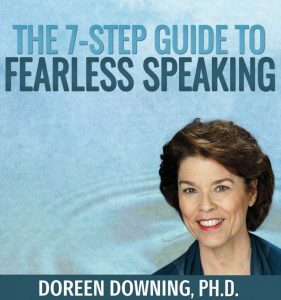 Podcast host, Dr. Doreen Downing, helps people find their voice so they can overcome anxiety, be confident, and speak without fear.
Get started now on your journey to your authentic voice by downloading my Free 7 Step Guide to Fearless Speaking: doreen7steps.com.
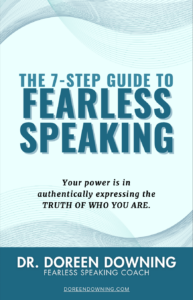 Podcast host, Dr. Doreen Downing, helps people find their voice so they can overcome anxiety, be confident, and speak without fear.
Get started now on your journey to your authentic voice by downloading my Free 7 Step Guide to Fearless Speaking: doreen7steps.com.