Today's Guest: Beth Erlander
Today, I interview Beth Erlander, a grief expert and therapist who spent years believing she had to stop being a caregiver before she could truly support other caregivers. Although she had helped people through grief for more than 26 years, Beth hesitated to focus on this work because she was still living it herself.
In our conversation, she didn’t think she was ready, and she wasn’t sure she had enough distance from her own experience to guide others through theirs. She shares what helped her stop waiting, why she finally became comfortable with not having all the answers, and how her own experience gave her a deeper understanding of the people she felt called to serve. We also explore why grief is more than death loss, how it can show up in life’s transitions, and what it means to give grief a voice.
Today, Beth helps those who unexpectedly find themselves caring for a spouse or partner navigate the emotional realities of caregiving. Through her professional experience and her own journey, she is creating programs that help caregivers feel seen, understood, and supported while navigating a grief that often goes unrecognized.
__________________
Beth Erlander, LPC, grief expert and seasoned therapist with over 26 years of experience. She works with grief and loss issues from any kind of sudden life transition. Yet the main focus of her work is serving those who find themselves thrust into the role of being the caregiver for their spouse or partner.
Her memoir, Life Upside Down: The Fall That Transformed Our Lives, Lifting Me Through Grief Love and Quadriplegia speaks to the journey of being her partner’s caregiver for the past 13 years.
Beth is a Creative Grief Support Practitioner, Art Therapist and EMDR practitioner. She is currently training in Somatic Experiencing, Peter Levine’s work where she is gathering more tools to equip grievers to navigate the overwhelming experience of grief in the body.
Beth runs an online program called The Wheel of Grief, which gives grievers a map to navigate the wild terrain of loss. She co-leads grief rituals and ceremonies, both online and in person. She is also a Cowry Shell Diviner taught to her by the late and great Elder Malidoma Somé.
Watch the episode:
Connect with Beth Erlander
Learn How to Speak Without Fear!

Also listen on…
Transcript of Interview
Transcript of Interview
Find Your Voice, Change Your Life Podcast
Podcast Host: Dr. Doreen Downing
Free Guide to Fearless Speaking: Doreen7steps.com
Episode #188 Beth Erlander
“Finding a Voice for Unspoken Grief”
(00:00) Doreen Downing: Hi, this is Dr. Doreen Downing. I host the Find Your Voice, Change Your Life podcast, and here is where exactly my guests, you listeners, get to follow somebody’s story, somebody’s journey, a time when they felt like they didn’t have a voice, or a time when they felt like they weren’t heard, or when they were developing perhaps a new sense of themselves which required a different kind of voice.
Today, I think this latter one may be what we’re in for. Well, what we’re in for. Up for, in for, however you want to put it. My guest is Beth Erlander. Hi, Beth.
(00:49) Beth Erlander: Hi, Doreen.
(00:50) Doreen Downing: You sent me a bio. I want to read that so people get some instant information about who you are and what you do, and then we’ll open up the conversation and see where we get to go explore and uncover.
Beth Erlander is a grief expert and seasoned therapist with over 26 years of experience. She works with grief and loss issues from any kind of sudden life transition, yet the main focus of her work is serving those who find themselves thrust into the role of being the caregiver for their spouse or partner.
Her memoir, Life Upside Down: The Fall That Transformed Our Lives, Lifting Me Through Grief, Love, and Quadrape- I knew I’d get that.
(01:55) Beth Erlander: Quadriplegia.
(01:57) Doreen Downing: I practiced that one. Oh my gosh.
(01:59) Beth Erlander: It’s a tough one.
(02:00) Doreen Downing: Yes, but you know it inside and out and have probably said it many, many times. Quadriplegia. There.
Speaks to the journey of being her partner’s caregiver for the past 13 years. Beth is a creative grief support practitioner, art therapist, and EMDR practitioner. She is currently training in somatic experiencing, and that’s Peter Levine’s work, where she is gathering more tools to equip grievers to navigate the overwhelming experience of grief in the body.
Beth runs an online program called The Wheel of Grief, which gives grievers a map to navigate the wild terrain of loss. She co-leads grief rituals and ceremonies both online and in person, and she is also a cowrie shell diviner, taught to her by the late and great elder Malidoma Somé.
Beth’s life’s mission is to normalize grief and help others know grief’s medicine.
I’m going to repeat that last line because I think this is why I’ve invited Beth on today. Basically because it seems like we’re taught something about grief, and here she is, this woman who’s lived it and knows it from the inside out, and is now helping people normalize it. Imagine that. Normalize grief and help others know grief’s medicine.
That’s a big breath, but that’s what I wanted to acknowledge you for and to also say thank you for the work that you do, and for being in this arena where I’m just feeling it already, where people suffer a lot and need the medicine and need guidance. Yay you.
(04:08) Beth Erlander: Yes. Thank you. Thank you so much, Doreen. It’s a pleasure to be here.
(04:12) Doreen Downing: When you heard me read that, what came to mind? How are you responding right away here?
(04:18) Beth Erlander: To the entire bio or just that last line?
(04:20) Doreen Downing: Well, all of it. Just anything that pops out.
(04:25) Beth Erlander: I mean, it’s good to hear that read back to me. I’ve done lots of things, dabbled in different ways in bringing different modalities together, and I think my work is also constantly evolving and changing. So, yeah. No, I feel proud. I feel proud.
(04:46) Doreen Downing: Good. I guess that’s why I referenced that last line because I wanted to appreciate you for the fact that you are on some front lines that many people don’t want to go to.
(05:04) Beth Erlander: So thank you.
(05:06) Doreen Downing: Usually in the podcast, I do kind of a chronology, like starting where they were born. Usually it’s early life where people don’t have a sense that they’ve got a voice, or that it’s respected or welcomed or applauded, yay you kind of thing, early on. Then they have this life journey, and somewhere along the line they wake up and say, “Oh, I need to find my voice.”
We talk about the journey and then what they do now. But I feel like today’s a little bit different, and that’s what I’ve been telling listeners because it seems like if you want to give us a little grounding of some background. But I think what’s most important is what’s going on now currently in your life in this last year since I’ve known you.
Major kind of coming to terms with what is for you in order to do this newer work about caregiving with caretakers who are taking care of spouses and partners.
(06:10) Beth Erlander: Caring for the caregiver.
(06:13) Doreen Downing: Yes.
(06:13) Beth Erlander: It’s been an interesting journey. So this year, 2026, will be our 13th year of, I always call it, like both of us. I don’t have quadriplegia, but we both deal with quadriplegia.
So it’ll be 13 years because it happened in 2012. For the longest time, I didn’t even consider working with caregivers because I was too in it. In fact, I remember when Michael was in a rehab hospital, I asked somebody who was working with us, “Is there a caregiver support group?”
She knew I was a therapist, and she said, “No. Why don’t you start one?”
The look on my face must have been like, if I would have said something out loud. I don’t know if it’s okay to cuss on the show, but I cuss a lot. Especially during the accident time, I cussed a lot. But I was like, “You gotta be fucking kidding me. I need support. How can you even ask me to provide support right now?”
So it has taken me 12 years for me to start to realize, “Oh, it’s time.” I think it happened in a number of different ways, but I started working with a few caregivers, and the resonance and the feedback I was able to give and what they were able to receive, and the connection, was just palpable.
Really, that’s where I was like, “Oh, I love working with these people.” So I was like, “Okay, I think it’s time. It’s time.”
(08:06) Doreen Downing: So before the quadriplegia—
(08:11) Beth Erlander: It’s better to say in Spanish, quadriplegia. I think it’s—
(08:15) Doreen Downing: Quadriplegia. Yes. We got the two ha ha’s at the end. Yes. So before that, you were a therapist, but you weren’t doing grief work?
(08:26) Beth Erlander: I was doing grief work, but I was like, “I’ll work with any grief work.” Since our culture associates grief with death loss, I was mainly holding space for people who had death loss.
I had to do a lot of education when I would speak to people at networking events and just all across the board. Like, “I work with grief.” I would often teach about how grief is more than death loss. But people just assumed that’s all I work with because, in our culture, it’s so limited to grief equals death loss.
(09:05) Doreen Downing: Yes.
(09:06) Beth Erlander: Someone died.
(09:07) Doreen Downing: Yes. Then I guess before we go further and talk about what’s happening currently or in this last phase of your life, how did you gravitate towards grief of transition and other kinds besides loss? How did you find yourself doing that? Do you have a sense of what the root of that was for you?
Because we didn’t go back and hear about early life, so I’m starting to get curious. Well, how did she find her… How did I get here? Yes, how did she find herself doing that kind of work?
(09:44) Beth Erlander: Well, I specifically went into grief work after my partner’s accident. Although prior to that, I did an internship in my graduate school for a hospice.
I wrote a thesis on using art therapy, using the mandala, with grief. So I did a children’s grief group, which was a lot of fun. I worked with one woman who, I forget the term, but she basically… Well, she was in a motorcycle accident and lost below her ribs and everything below it, and her legs and her pelvis and all that.
So anyway, I was working with her also during that time.
(10:32) Doreen Downing: Well, when I did my PhD, it was on weight loss maintenance and management, which is an issue that I’ve always had and still have.
However, there was a reason why I leaned into that and found myself working at a hospital and working with weight loss maintenance groups in a hospital. Then I used them as subjects for my research.
So I can get the connection between myself and what happened in my life, my own struggle. But was there anything prior to your husband’s accident? You’re talking about being in school and doing this dissertation or this thesis.
(11:21) Beth Erlander: Yes.
(11:21) Doreen Downing: What about before, in grief and loss of any kind or transitions in your life, when you kind of trace back from childhood to teenager to early adulthood?
(11:34) Beth Erlander: Oh, that’s interesting. You know, I think I’ve done a grief timeline. I mean, I think even just coming into the world is grief-y because—
(11:43) Doreen Downing: Oh, that’s wonderful. I love hearing that. Say that one more time.
(11:47) Beth Erlander: Coming into the world is grief-y because we come from our mother’s womb, where we have all our needs met. Yes. And it starts to get tighter and tighter and like, “Okay, wait. Something’s happening here.”
Then the process of birth can also be very challenging and can be full of grief. Well, I think for the child and for the mother, there can be grief there.
(12:13) Doreen Downing: Yes.
(12:13) Beth Erlander: So I think we start with grief.
(12:16) Doreen Downing: Uh-huh. The way you say it is an aha for me, actually, even though it’s so true and so obvious. I hope the listeners are going to have a mouth drop also because it’s so clear. It’s so obvious. Yes.
(12:34) Beth Erlander: Right. Right.
(12:35) Doreen Downing: For both. Our arrival is full of joy, but we also left something really safe and secure behind.
(12:44) Beth Erlander: Yes, and I don’t think we talk about the grief of childbirth.
(12:49) Doreen Downing: No.
(12:49) Beth Erlander: Both for the baby and for the mama. I have lots of friends who have children. I don’t have children, so I don’t know that process, but I have girlfriends who say, “Yes, it was not the birth I wanted. It was not how I planned that.”
You know, and there’s grief around that process. Yes. Then the whole issue of their identity changes. So, you know, there’s that.
But in looking back at my own life, I think there’s been lots of transitions.
(13:22) Doreen Downing: Name just a few that seem to pop when we talk about grief.
(13:27) Beth Erlander: I really struggled when I was in junior high. I would say that year was the worst year of my life, along with 2012 when my partner had his mountain biking accident.
In seventh grade, the way our school worked, our grade school went to grade six, and then junior high was seventh through ninth grade. So my middle school experience, I was in middle school and my best friend was in sixth grade, so I knew no one.
I felt like, and I was a shy child. One of my teachers told my parents, “I’m worried about Beth. When she goes to high school, she’s just gonna fade into the woodwork.”
You know, because I hardly spoke. So I didn’t have a voice in junior high. That was a hard transition, and I think middle school is a hard transition for most of us.
(14:32) Beth Erlander: I don’t know any person who said, “Oh, yes, middle school was great.”
(14:36) Doreen Downing: Right.
(14:37) Beth Erlander: Because of all the changes that are going on in our bodies and our hormones and just life.
So that was a struggle. Then I would say probably in college I had some struggles too, transitioning from college into what was next. I felt like I got very little support for that.
Also, I was an art major. At the end of my time there, I met somebody who was very smart. He actually got a dual degree in business and art, and I was like, “Well, why didn’t I do that?” Because you have to know how to market yourself and make money, not just make art.
So eventually I found art therapy, and that was from being in a… I traveled to Europe, and I was staying at the Findhorn Foundation.
(15:32) Doreen Downing: Oh, yes, I remember that. I don’t hear much about it nowadays, but I remember it was a place where things were magical and vegetables would grow really big, and there was just a lot of good, I don’t know, growing energy there, I guess you might say.
(15:51) Beth Erlander: Yes. So I was there for quite a while. I think I was there for about 10 months. I’m forgetting now.
Then I went to travel by myself, and I’m like 24. I woke up one day, I was in Edinburgh, and I was supposed to go out and see the sights, right? And I woke up with so much grief and sadness, and I was like, “What is this?”
I grabbed my watercolors, and I made myself paint. I wish I had the image. Usually, I have it somewhere around, but I’m in a state of transition right now, which we could also talk about.
Anyway, it was like this blue eyeball breaking this heart. The heart is breaking, and this eye is in the middle.
After I painted that, I realized, “Oh, I’m just missing the people that I was connected to on a daily basis, and now I’m by myself, and I’m just grieving.”
As soon as I noticed that and that was mirrored to me, that feeling of sadness was gone, and I was like, “Ah, can I help others use art to heal?”
Then I met an art therapist on my travels, and so that seed got planted then because my initial studies in graduate school were in art therapy.
(17:18) Doreen Downing: Yes, the synchronicities and the little steps along the way.
Before I take a break, I want to go back to… I am really curious about where you were born, what sibling you are, what your parents were like with you early on.
(17:36) Beth Erlander: I’m the middle child, and I have two brothers on either end. What else did you want to know? Like, birth order?
(17:45) Doreen Downing: Just anything that pops given our conversation now.
(17:52) Beth Erlander: My dad is a Lutheran minister, so I grew up with him. His dad was, and his uncle was. My uncle, so his brother.
So I come from a lineage of men who speak, you know? Their sermons, and they’re public, and doing that. So that’s kind of interesting.
My mom is a nurse.
(18:19) Doreen Downing: Uh-huh. Yes. Well, then I can see. Good. That makes sense then perhaps about nurture and nature… Maybe your nature is more of an introvert, quieted, but that doesn’t mean that you’re quiet.
Introverts don’t necessarily go hide. They still have a sense of where they feel safe.
Your mom being, I would say, a healer, even though you’re calling her a nurse. I think nursing is healing.
Good. I wanted to just get a little bit more of what that might have been like to have this father who’s… I mean, being an introvert, you probably couldn’t match up to his way of taking up space and speaking.
(19:08) Beth Erlander: I don’t know. I probably could.
I will share a story too, because I learned this when I was in college. I was doing a project creating a childhood shrine for one of my classes, which was great. So I had to call them and ask what I was like as a little toddler because I didn’t remember.
They were like, “Oh, Beth, you were the leader of the neighborhood. You were bossy, and you told people what to do.”
So I was like, “What?”
Because I don’t know that part of me, but that’s how I first started my life, being really in charge and speaking more, telling people what to do.
(19:55) Doreen Downing: Yes. Well, it does relate to the kind of work that you do now. Seeing what needs to be done or helping people, guiding them toward… I don’t know what being a leader as a little girl naturally is, but it seems like it would show up in the work that you do now.
(20:15) Doreen Downing: I definitely want to hear more about the two things you’ve referenced already. What happened in 2012, and then what you’re doing nowadays for sure.
You said there’s this move, and you kind of said… Didn’t you say—
(20:32) Beth Erlander: Oh, that I’m in transition?
(20:34) Doreen Downing: Transitioning.
(20:35) Beth Erlander: Yes. I don’t know if I need to go into that, but we’re dealing with mold in our house. So all my things are not around me like they normally are.
(20:44) Doreen Downing: Oh, I see. But still, the way that you’ve put grief out for me today, and then what we’re talking about is normalizing it.
It feels like, “Oh, where are my things?” There’s even something there. Yes. And it doesn’t have to be major, major grief.
So there’s a sliding scale, and it’s all grief.
(21:07) Beth Erlander: Yes.
(21:08) Doreen Downing: We’ll be right back.
(21:10) Beth Erlander: Okay.
(21:13) Doreen Downing: Hi, we’re back with Beth Erlander, grief support specialist, I would say. Someone that I’m learning from today, and I’m very, very excited to have already uncovered some little nuggets.
They’re so rich already that I feel like I have a pile full of information that I haven’t really thought of before. Like grief when we’re born, that there’s an experience there. We’re leaving something and we’re transitioning.
So what Beth is helping me see already today is that transition, no matter what, feels like there could be elements of grief in it. That’s what we’re talking about today, and we’re back now.
Hi, Beth.
(22:00) Beth Erlander: Hi.
(22:02) Doreen Downing: So let’s move on into… We understand some of the ways in which you found yourself doing therapy around grief, and then your partner’s accident. You wanted support, and it wasn’t available.
(22:25) Beth Erlander: It was not available, and that was actually a really challenging time for many reasons.
Number one is that he went from being an able-bodied person to being a high-level quadriplegic in an instant. So there’s that, and then learning how to deal with all of that.
There was also that I was feeling so much grief, and I was trying to read about grief, looking online for grief support. Mostly, I found people who speak of grief as death loss.
I often was very annoyed because I was in a grieving process, but the materials I was finding did not reflect that. It was not mirrored back to me. So I felt like I didn’t fit in, even in the grief community.
(23:29) Doreen Downing: Wow.
(23:30) Beth Erlander: Because it was mostly death loss at that time, and what I was finding, instead of life transition and naming, is that there are life transitions that are also full of grief.
We don’t have to just lose someone to death to experience grief and loss.
(23:50) Doreen Downing: And then moving forward, you said that you weren’t able to actually focus on caregivers. Now we’re talking more about this last year that I’ve known you, learning more about what it means to give care, like you say, to caregivers.
To me, that feels like I’ve been watching you find your voice currently.
(24:22) Beth Erlander: Yes, and it’s… I want to speak to caregiver grief because that’s what I was experiencing.
I had to become my partner’s caregiver at the young age of 42, and nobody was holding the grief that I was experiencing of losing what we had.
I think that’s part of the challenge because we’re so focused on what’s happening now. One of the big things about tending to caregivers is that when they’re tending to their partner or their spouse, most of the attention is on that because they’re the one that has the disease or the accident or this.
You know? I experienced that quite often, people not really talking to me, like, “Well, how are you, Beth?” A few people did that, but it was more like, “How’s Michael?”
(25:14) Doreen Downing: Yes.
(25:14) Beth Erlander: If I’m out in public and Michael’s not around, “Well, how’s Michael doing?” Especially in the beginning.
So the grief gets left behind. As I’m saying that, I can feel my own unprocessed grief arising, actually. Just to remember that time.
(25:38) Doreen Downing: This is you finding your voice, I think. Exactly what it takes is to feel into where it’s hard to talk about it.
Because you feel it, you remember it. Or this is what I just noticed with you.
(25:57) Beth Erlander: Yes.
(26:05) Doreen Downing: Then what can you say about caring for the caregiver? Just see what comes naturally. See what comes about it, what it means.
(26:24) Beth Erlander: Well, I think it can be a very lonely place.
To provide support to someone who’s going through a similar experience as I did… I think that’s why the sessions I’ve had so far with some of the caregivers I’ve already worked with, that’s why it feels so good.
They ask me questions sometimes that are like, “Well, can I ask you this question?”
And I’m like, “I’m an open book, and if you’ve read my book…”
I talk about many things there. There’s a chapter on sex. I’m pretty open with my process with people, and that’s also something that became very important to me because that actually became one of my biggest losses, my able-bodied sex life.
I felt like it was really important to put that in the book.
So I tell people, “You can talk to me about anything,” and I feel like it’s so helpful for them to be able to ask those questions that are hard to ask.
(27:38) Doreen Downing: And the other thing I guess I felt right then when you tapped into the emotion and the memory and the physical, the embodied memory, is that if somebody is working with you and they start to feel something, you can feel it also.
(28:00) Doreen Downing: And they know somebody really knows how they feel deeply, even though they haven’t yet expressed it or tapped into it in a way that needs to be spoken about, perhaps. Articulated.
(28:15) Beth Erlander: Yes, absolutely.
(28:16) Doreen Downing: Yes. I think that’s the word you used when we first started today, resonance.
Right? Yes. That you feel the resonance because you’re feeling what the person’s feeling. Yes. That’s partly your gift, to be able to feel it and to know it, acknowledge it like you did with me, and accept it.
(28:41) Doreen Downing: So let’s talk about medicine.
(28:45) Beth Erlander: Grief as medicine?
(28:46) Doreen Downing: Yes.
(28:48) Beth Erlander: Grief as medicine is the only way to get through it. Well, we get through a process. I mean, grief is an initiation process, and if we put it outside of ourselves or try to keep it away, it’s actually going to do more harm.
So it’s about inviting it in and realizing, “Okay…” I see it as a human. I often speak of grief as being a disheveled human that shows up at the front porch, and it’s knocking at the door, and it’s hanging out, and it’s kind of being a nuisance.
But it wants to get your attention, and all it wants is to come in and be known.
So I say you’ve got to invite it in for tea and cookies and start to learn who it is.
(29:42) Doreen Downing: In my work with people and speaking anxiety, I know exactly what you mean about learning to go towards it with compassion.
How do you help people come to that, like you say, invite it in with tea and cookies, when there’s so much resistance?
(30:02) Beth Erlander: That’s hard. That’s hard.
Sometimes people don’t want to. I mean, I think that’s why they come to see me, because finally they realize, “Okay, I need some support with this.” Because I don’t want grief to be a part of my life.
(30:16) Doreen Downing: Yes. But there’s a new way to be with it that gives you more access to more of you.
At least that’s my understanding of the work that I do with unprocessed fear, I guess you might say. I hadn’t thought of my work as unprocessed fear.
(30:42) Beth Erlander: Yes, so a lot of the work is teaching them to be okay with whatever emotion shows up, right?
Teaching about emotions as they come and go, and they’re not here forever. Grief comes in waves. I teach them how to be with the grief. I call them grief bursts when they show up.
(31:01) Doreen Downing: Ah, yes.
(31:02) Beth Erlander: You know, and what to do with their bodies if they can’t deal with the grief burst in the moment. Like if they’re out in public or in a meeting, because these grief bursts come out of nowhere.
Then teaching them about their nervous systems as well, understanding how they feel in their body when it shows up and how to support it. As simple as, “Let’s put a hand there.”
(31:27) Doreen Downing: Yes.
(31:28) Beth Erlander: Do you notice a difference when you just place a hand on your heart and just breathe?
(31:34) Doreen Downing: Yes. Ooh. That’s nice to do with you right now.
When I saw you put your hand on, it made me do that too. I think that when you’re really listening to somebody, and if they’re really listening to you, by you just doing that one gesture. It helped me put my hand on my heart and take a breath and be with.
I think that’s what we’re also talking about with grief, is the be with.
(32:11) Beth Erlander: Yes, I talk about befriending grief.
(32:14) Doreen Downing: Yes.
(32:17) Doreen Downing: Well, as we move to coming to a close now, is there something that you want to say about the work that you do or the work that you’re, I don’t know, designing?
(32:30) Beth Erlander: I’m in an in-between phase.
You know, I just finished a group program that was about general grief, and now with this new insight coming in about focusing on caregivers, I need to recreate it just for caregivers.
I’ve given myself April off to not do or push or create. It’s sort of in an incubator stage. Things are starting to come in, so I’m allowing that creative process to come forward in a more organic way.
My social media posts are going to be changing in May. In the next few months, you’ll see more caregiver posts and speaking about caregiver grief.
I’m hoping to have an online program for caregivers and their caregiver grief. I think it’ll either be three or four months, probably starting in the fall.
I’ll probably do what I did last year because I really love supporting people starting in the fall. Fall is the time of grief, especially here in the Northern Hemisphere, because nature is dying. Things, leaves are falling.
So it’s like, “Let’s gather in the time of grief.”
I love supporting them through the winter and into the coming of spring.
(34:03) Beth Erlander: It’s especially important, I think, to have more support during the holidays because that’s a really hard time for people who are grieving.
So, yes, that’s what I’m creating.
(34:18) Doreen Downing: Good. Especially in the fall that you talked about, by the time the holidays come, the group would have already been cohesive and supportive, and they trust and know each other by then.
Since this is about voice, I was wondering, do you think in the way that you talked about and you put your arm out in inviting and being friendly with grief, does grief have a voice?
(34:50) Beth Erlander: Absolutely. I think grief has a voice. Yes. Yes, and I think we need to give expression to that voice.
In my groups, I often have people write prompts to a certain theme, and then it’s great if we can read those out to each other. If people don’t want to write, they can also draw.
I am excited to bring in more art and creativity into my programs as well. I’m kind of returning to my art therapy roots, and I’m like, “Ah, I’ve missed the art therapy component.”
So I’m going to be bringing more of that in as well.
(35:39) Doreen Downing: Yes. Well, in terms of grief having a voice, I think there’s also the listener. So you, as somebody who’s developing programs where grief can have a voice.
Because you can listen to it. You can receive it. You don’t have a judgment. You’re not trying to push people through something.
You’re helping them discover that voice of grief much more, I think.
(36:08) Beth Erlander: Yes.
(36:10) Doreen Downing: So in this last… This idea that you are moving from being kind of a general helping people go through transitions and seeing that as some form of grief, and you’re becoming clearer around focusing just on caregivers.
Is there any kind of different identity? Is grief showing up there?
(36:42) Beth Erlander: Yes. I mean, I think that’s one of the reasons why I’ve hesitated. Also, just not feeling like I was ready, or feeling like I had to not be a caregiver to be supporting caregivers, if that makes any sense.
Like, I need to be away from it, but I’m still in it.
So yes. I know I’m not going to be only working with caregivers because I still do grief work, but it’ll be interesting. I have some, like, “Oh, am I going to be working with only caregivers?”
My life as I know it right now, and the clients who are showing up right now, I’m not going to work with those clients? I don’t know. We’ll see what happens.
But yes, there’s definitely some grief there, for sure.
(37:30) Doreen Downing: One of the things I read in what you wrote to me beforehand was that you are comfortable in the “not knowing”.
I’m really glad to see you and be with you during this life moment of a transition that’s happening and yet hasn’t really grounded.
(37:57) Beth Erlander: No, I’m in transition right now.
(38:00) Doreen Downing: Yes. That’s why I was excited about interviewing you, because you’re in transition, you’re finding your voice.
But there’s a voice that’s leading you to it, and it’s the voice of having felt like, “Oh, it’s really true. I have had this experience, and I know it from the inside out. Therefore, I know I can help.”
(38:28) Beth Erlander: Yes, absolutely.
(38:31) Doreen Downing: Well, a little bit of space now. A breath.
Notice if something comes through. What might want to come through, since we’re talking about easy doing, knowing and the “not knowing”.
See what last words want to show up for you here.
(38:50) Beth Erlander: Yes. My book is coming into my consciousness. I want to just shout out for that, and you mentioned it in the beginning.
It also makes sense to focus on caregivers because my book is about my process of becoming a caregiver and the transition I went through since my partner’s accident.
It makes more sense because it speaks to… I’m my ideal client, right? So it speaks to the caregivers who are suddenly thrust into that, “I have to care for my partner, who has been able-bodied through our entire relationship, and now it’s all on me.”
There’s a lot that’s really beautiful in the book, and I think it’s very supportive. It’ll be a great companion guide for them in the program.
So I’m excited. It’s just all coming together and making so much sense.
(39:52) Doreen Downing: Yes. I see the excitement, and I’m glad to give you a platform to share it and to share what’s coming up too.
Thank you so much.
(40:02) Beth Erlander: Thanks, Doreen. Thanks for having me.
(40:04) Doreen Downing: Yes.
Also listen on…
 Podcast host, Dr. Doreen Downing, helps people find their voice so they can overcome anxiety, be confident, and speak without fear.
Get started now on your journey to your authentic voice by downloading my Free 7 Step Guide to Fearless Speaking: doreen7steps.com.
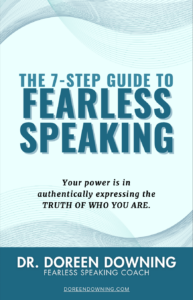 Podcast host, Dr. Doreen Downing, helps people find their voice so they can overcome anxiety, be confident, and speak without fear.
Get started now on your journey to your authentic voice by downloading my Free 7 Step Guide to Fearless Speaking: doreen7steps.com.